



Core regulatory obligations
Under Directive 2001/83/EC and Regulation (EC) No 726/2004, the MAH must ensure that the outer packaging, immediate packaging and package leaflet strictly reflect the content of the approved marketing authorisation (SmPC and annexes).
This includes:
- Use of the officially approved name, strength, pharmaceutical form, and composition.
- Inclusion of mandatory particulars such as batch number, expiry date, storage conditions, route of administration and safety warnings.
- Correct language versions in all Member States where the product is marketed, in line with national language requirements.
EU GMP Part I (Ch. 5 and 6) and Annex 15 reinforce that labelling operations are critical GMP steps; the MAH must ensure that packaging sites (own or contracted) operate under a validated, controlled system, including line clearance, reconciliation, and checks to prevent mix‑ups.
The Falsified Medicines Directive (FMD) (Directive 2011/62/EU) and Commission Delegated Regulation (EU) 2016/161 add specific requirements for safety features, namely the 2D data matrix and anti‑tampering device on prescription medicines, which must be correctly encoded, printed and uploaded to the European Medicines Verification System (EMVS). (Watch out for our next article for more in depth insights on FMD)
Governance, outsourcing and quality system expectations
Even when artwork, printing and packaging are outsourced, the MAH retains non‑delegable responsibility for ensuring that all labelling and packaging used on the market is correct and compliant. A robust MAH Quality System should therefore cover:
- Approved artwork management, with version control and traceability between regulatory approval, artwork files and printed components.
- Technical/quality agreements with CMOs and packaging material suppliers, clearly defining responsibilities for proofreading, component approval, line checks and deviation management.
- Change control processes ensuring that regulatory variations, safety updates and changes are translated promptly and accurately into updated packaging.
- Supplier qualification and periodic audits of printers, artwork studios and packaging sites.
Regulators expect integration between regulatory affairs, pharmacovigilance, quality and supply chain so that new safety information, labelling variations and recall decisions are consistently implemented across all markets.
Common inspection findings related to labelling and packaging
Inspection reports from EU authorities frequently cite MAHs for weaknesses in labelling and packaging control, including:
- Use of obsolete artwork or printed components: old versions of leaflets or cartons remaining in circulation due to poor component control or inadequate segregation of superseded versions.
- Inconsistent implementation of variations: updated SmPC/PL wording approved centrally or nationally but not fully reflected in all packaging components, languages or pack sizes.
- Translation errors and omissions: safety warnings or posology sections incorrectly translated or partially omitted in certain language versions, often where local affiliates or external vendors were insufficiently supervised.
- Missing or incorrect safety features: 2D codes not readable or non‑compliant, wrong product codes or mismatches between printed data and EMVS uploads, leading to scanning failures at pharmacy level.
- Inadequate batch‑specific checks: insufficient pre‑printing proof checks, weak reconciliation of printed components, or lack of independent verification of critical information (product name, strength, batch, expiry).
- Poor complaint and deviation trending: failure to adequately investigate and trend labelling‑related complaints (e.g. unreadable text, wrong language leaflet, mismatched blister/carton) and to implement CAPAs across all affected markets and CMOs.
These findings often link back to gaps in the MAH’s central governance, for example, fragmented ownership between regulatory, marketing and supply chain; absence of a single, controlled repository for approved artwork; or weak oversight of third‑party artwork and translation providers.
Complaints, quality defects and recalls
Under EU legislation and GMP Chapter 8, the MAH must operate a system for complaints and product quality defect investigations, including those arising from labelling errors. Typical triggers include:
- Wrong language leaflet in a pack.
- Incorrect strength or dosage instruction printed.
- Missing warning or contraindication.
- Misaligned or illegible text, batch number or expiry date.
For each case, the MAH must assess potential impact on patient safety and determine the need for a recall or other market action in line with EU and national recall guidance. Communication with competent authorities must be timely and coordinated, with clear explanation of root cause, scope (batches, markets), and proposed corrective and preventive actions.
Where safety features are involved, for example, systematic EMVS decommissioning failures or widespread unreadable 2D barcodes, authorities may expect broader recall or rework, and scrutiny of the MAH’s serialization and packaging controls.
What good practice looks like for MAHs
In practice, a compliant MAH environment for labelling and packaging control will demonstrate:
- A single, controlled artwork and labelling repository linked to the approved MA dossier, with rigorous change control.
- Formal, documented proofreading and approval workflows, including medical, regulatory and quality checks for all languages.
- Validated packaging processes at all CMOs, with routine performance monitoring and periodic audits.
- Effective complaints and defect trending, feeding into risk assessments, PQRs and management review.
- Clear integration between pharmacovigilance, regulatory affairs and quality, ensuring that new safety data and variation approvals rapidly translate into packaging updates and market implementation.
By treating labelling and packaging as a strategic MAH obligation rather than a purely operational task, companies can significantly reduce their exposure to inspection findings, quality defects and costly recalls while ensuring that patients receive medicines with accurate, legible and up‑to‑date information.
If you recognise any of these weaknesses in your own labelling and packaging controls, now is the time to act rather than wait for an inspection finding.
MIAS Pharma can partner with MAHs to design and implement robust governance, strengthen CMO and supplier oversight, and embed compliant change control, deviation management and recall processes into the MAH Quality System.
Whether you need a focused gap assessment, support preparing for an upcoming inspection, or ongoing fractional expertise to oversee labelling, packaging and FMD safety‑feature implementation, MIAS can help you move from reactive fire‑fighting to confident, inspection‑ready compliance.

By Eleanor Loughman – QP/Innovation lead at MIAS Pharma
Your partner in quality, safety, and compliance
The life sciences sector requires specialized knowledge and reliable support. With our broad expertise, we help organizations comply with laws and regulations, ensure quality, and continue to innovate with confidence.
Related services


Related articles

07 Apr 2026
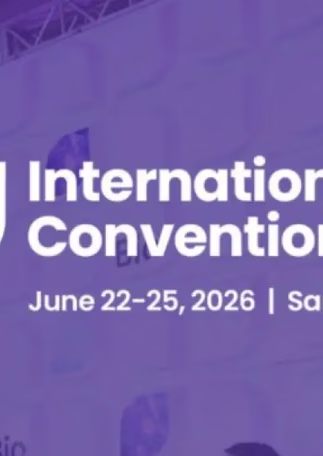
MIAS Pharma will be attending the BIO International Convention in San Diego, USA
MIAS Pharma is excited to attend the BIO International convention in San Diego, California, from June 22nd – 25th 2026. Visit us at booth #4052, we’ll be happy to connect.


01 Apr 2026
Let’s Meet at SNMMI Annual meeting 2026 LA
MIAS Pharma is excited to attend the SNMMI annual meeting in Los Angeles, California, from May 30th – June 2nd 2026. Visit us at booth #1363, we’ll be happy to connect.


13 Mar 2026
Getting ready for product launch with serialisation
As your medicinal product moves from the clinical space into commercial launch territory, one crucial question looms large:


06 Mar 2026
MAHs: Are Your GMP–GVP Interfaces Aligned?
Calling all Marketing Authorisation Holders (MAHs) are you set up for success? Have you confirmed whether your five‑year renewal is required? Is this critical information visible and accessible to your QPs and QPPVs?


27 Feb 2026
MIAS Pharma: End to End MAH services for Virtual and Rare Disease Companies
For small and virtual companies, especially those developing rare disease medicines, the requirements of acting as a Marketing Authorisation Holder (MAH) in the EU can feel overwhelming. EU legislation places the MAH at the centre of responsibility for the quality, safety and efficacy of the product throughout its lifecycle, regardless of how many activities are outsourced. MIAS Pharma is designed to be your one integrated partner in Europe: an established presence with the expertise, infrastructure and network to assume day‑to‑day MAH obligations on your behalf while you focus on science, patients and portfolio strategy.


20 Feb 2026
Quality & Regulatory Implications from EU Critical Medicines Act
The European pharmaceutical landscape is entering a period of major regulatory transformation with the introduction of not only the EU Critical Medicines Act (CMA), new pharma package.
28 Jan 2026
Navigating Evolving EU Marketing Authorisation: Are You Ready for Tomorrow’s Compliance?
As the European pharmaceutical landscape transforms, Marketing Authorisation Holders (MAHs) now face a broader – and more demanding – array of duties that stretch far beyond initial product approval. The new compliance reality encompasses critical operational areas like shortage reporting, environmental risk management, end-to-end product data maintenance, supply chain resilience, and more. These obligations often overlap with, yet are legally distinct from, manufacturing and wholesale authorisations – presenting new blind spots and risks for the unprepared.