
A Practical Approach to Root Cause Analysis
Production and quality teams immediately escalate the issue. Sterile production managers convene to assess the situation, and urgent decisions are made. Often, the areas where the APS was performed are placed under quarantine. Commercial sterile production may continue only until the current batches are completed, but no new batches are started until the cause of the positive APS result has been determined.
Typically, a special “war room” is set up, and a team of subject matter experts (SMEs) and quality representatives is assembled to begin the investigation.
Why It Matters
A failed APS has immediate and significant operational and regulatory consequences.
First, all sterile products are considered part of the investigation until the root cause is identified. As a result, product release is suspended.
Second, regulatory authorities must be notified. In Belgium, for example, companies are required to inform the Federal Agency for Medicines and Health Products that production of the affected product has been temporarily suspended due to a failed APS and that a root cause investigation is underway.
Finally, lengthy investigations can lead to production downtime, supply risks, regulatory scrutiny, and higher operational costs. For manufacturers of sterile products, the pressure to quickly and accurately identify the root cause is therefore enormous.
Typical Pitfalls in APS Investigations
In practice, there are several challenges that often complicate the root cause investigation following a failed APS.
- Unclear scope of the investigation: At the start of the investigation, the scope is often broad. If the investigation is not structured, teams may struggle to determine which products, processes, or production lines are actually affected.
- Lack of cross-functional expertise: A comprehensive root cause analysis requires expertise from multiple disciplines, including microbiology, engineering, quality, and manufacturing. Without the right expertise, investigations may overlook critical factors.
- Insufficient environmental data: Investigations sometimes lack supporting data on environmental monitoring or airflow analysis, making it difficult to identify the actual source of the contamination.
- Delayed coordination and decision-making: Without structured meetings and clear responsibilities, investigations can lose momentum, and corrective actions may be delayed.
- Delays in coordination and decision-making: Without structured meetings and clear responsibilities, investigations can lose momentum and corrective actions may be delayed.
Normec Advipro’s Approach in Practice
-
1.
Rapid setup of the investigation
A structured investigation framework is established immediately. SMEs and quality representatives form a dedicated investigation team, which often operates from a central “war room.”
-
2.
Broad initial assessment of the scope
At the start of the investigation, all sterile products are considered to be within the scope until there is sufficient evidence to narrow the scope of the investigation.
-
3.
Structured investigation management
Daily meetings at various levels help monitor progress, track action items, and ensure accountability within the teams.
-
4.
Technical Support for the Investigation
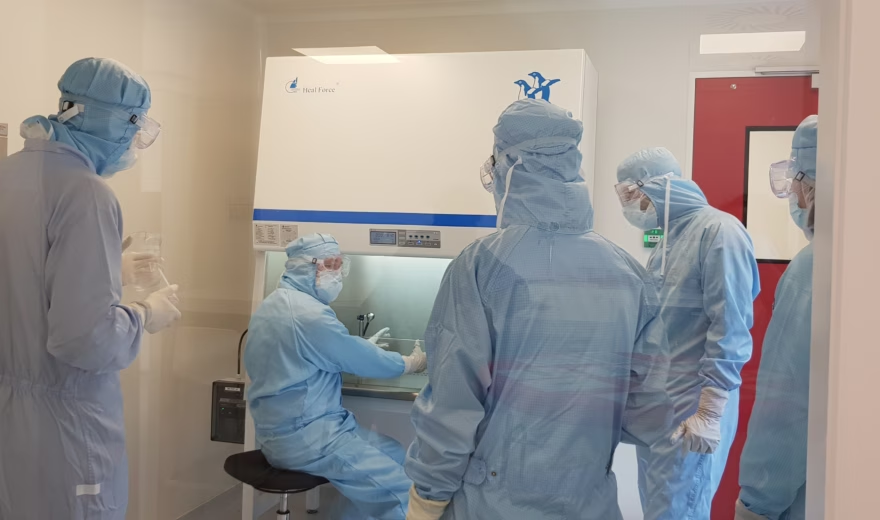
Technical investigations focus on identifying potential contamination pathways. Data from environmental monitoring are evaluated, and, if relevant, additional studies are conducted, such as air visualization studies (AVS) and microbial sampling.
As evidence is gathered, the scope of the investigation can be gradually refined, allowing certain production lines to resume operations while corrective and preventive actions (CAPAs) are implemented.
-
5.
Resumption of Production
Before commercial production can resume, several conditions must be met.
Three consecutive successful APS runs should be completed to demonstrate that the process is back under control. In addition, regulatory authorities should provide a positive recommendation before commercial manufacturing resumes.
Practical Recommendations
Based on our experience supporting manufacturers of sterile products, there are several approaches that can significantly improve APS investigations.
Begin the root cause analysis immediately: by engaging the investigation team quickly, production downtime is minimized and crucial data is captured while events are still fresh in everyone’s memory.
Use structured investigation management: Daily progress meetings and clear action tracking help maintain momentum and prevent delays.
Include airflow and environmental surveys where relevant: Visualization of airflow and microbial sampling can reveal contamination pathways that are not immediately visible.

Concluding Thoughts
A structured investigation approach, supported by the right expertise and technical tools, can significantly improve both the speed and quality of the root cause analysis following a failed APS.
If your organization is facing a complex investigation into sterile manufacturing, Normec Advipro’s experienced experts can support you with investigation management, technical studies, and the implementation of corrective actions. Normec Advipro’s MoVE team also provides support for air visualization studies (AVS) and environmental monitoring.

Meet our Normec expert:
Evelien Fossépré
Project Engineer
Evelien Fossépré is a consultant at Normec Advipro and specializes in sterile manufacturing and infection control. She is a certified QP with leadership experience in packaging and sterile preparation and has a QA background in the sterile department. In addition, she has experience supporting pharmaceutical manufacturers with investigations and validation activities, helping companies strengthen their regulatory compliance and operational reliability.
Your Partner in Quality, Safety, and Compliance
The life sciences sector requires specialized knowledge and reliable guidance. Thanks to our extensive expertise, we help organizations comply with laws and regulations, ensure quality, and continue to innovate with confidence.
Related services






Related Articles


16 Mar 2026
What do you know about EudraLex Volume 4 Annex 11:2026? Are your computer systems inspection ready?
The current version of Eudralex Volume 4 Annex 11 dates back to 2011 and is no longer fully up to date. The technological world has changed significantly since then. Requirements for lifecycle management and data integrity have become much stricter, and the use of cloud solutions in the pharmaceutical industry is now standard. Regulatory bodies such as EMA and PIC/S have indicated plans to revise Annex 11 to provide more clarity on its interpretation, guidelines for new technologies, and clear requirements for data integrity.
16 Jun 2025
Summer Storage: Protect Your Temperature-Sensitive Products
Discover how mapping works and why it’s essential for addressing the challenges posed by controlled environments. We’ll outline the best practices for effective summer mapping.
05 May 2025
Advipro Becomes Normec Advipro
Lille, May 5, 2025 – Advipro, an expert in consulting and project support within the life sciences sector, is taking a new strategic step. Starting in May 2025, the company will operate under the name Normec Advipro.


13 Sep 2024
Winter Mapping: Protect Your Temperature-Sensitive Products
Discover how mapping works and why it’s essential for addressing the challenges posed by controlled environments. We’ll outline the best practices for effective winter mapping.
31 Aug 2022
Where Can Normec Advipro Make a Difference? | PIC/S Standard
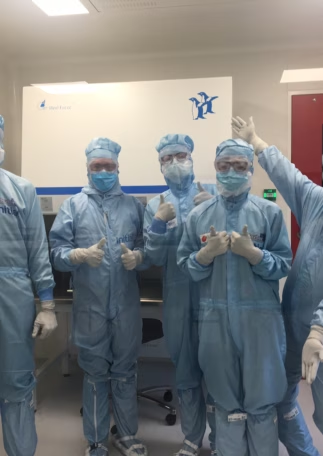
A new Royal Decree was recently published “concerning the preparation and dispensing of medicines and the use and distribution of medical devices within healthcare institutions.” You can read all about it in the blog “The New Regulations for Hospitals and Their Pharmacies.” Specifically, the regulations require work to be carried out in controlled environments (cleanrooms), where the handling of open containers must always take place in ventilated rooms with filtered air. For many hospitals, building and validating a cleanroom is a major undertaking, and they often lack the necessary in-house expertise. Collaborating with an expert like Normec Advipro offers enormous benefits. We work closely with the hospital and apply the “First Time Right” principle, which benefits the project’s quality, budget, and timeline. In the past, we’ve collaborated with various large and small hospitals, as well as university hospitals. Below, we outline a few project phases in which Normec Advipro provided real added value and share our three main lessons learned.


24 Feb 2022
5 Reasons to Choose a Career in Life Sciences
Choosing a career in pharma & life sciences is a forward-looking choice in a rapidly growing industry. But you must also make a conscious decision to enter this highly regulated and state-of-the-art sector.
24 Feb 2022
What is GxP?
Sooner or later, everyone comes into contact with medications, but we often don’t stop to think about everything that needs to be done to safely deliver a medication to the patient. When it comes to medications, patient safety is paramount. To ensure safety, various quality systems have been introduced in the pharmaceutical and food industries. These quality systems are divided into different categories. The general term for these quality systems is GxP. What does GxP mean, and why is it so important to implement quality systems in these industries?