About the Organization
The ARCHEMED association has set itself the goal of sustainably developing the medical infrastructure in Eritrea in order to improve the lives of local children.
The assistance is provided free of charge and without regard to national, religious, or political background.
The teams working to achieve this goal consist of approximately 250 medical professionals, nurses, midwives, technicians, skilled tradespeople, and engineers—all of whom are volunteers—and are drawn from around the world.
In addition to providing immediate medical care, another key focus is on the professional training of local doctors and nurses. This includes initiatives such as surgical care for children, general pediatrics (with a focus on neonatology), the development of perinatology—through safe childbirth support and the subsequent care of premature and newborn infants—as well as social projects and construction and infrastructure projects.
The entire organization is funded by donations of all kinds: monetary and in-kind donations from companies, foundations, and public institutions. In addition, there are many partnerships with other nonprofit organizations.
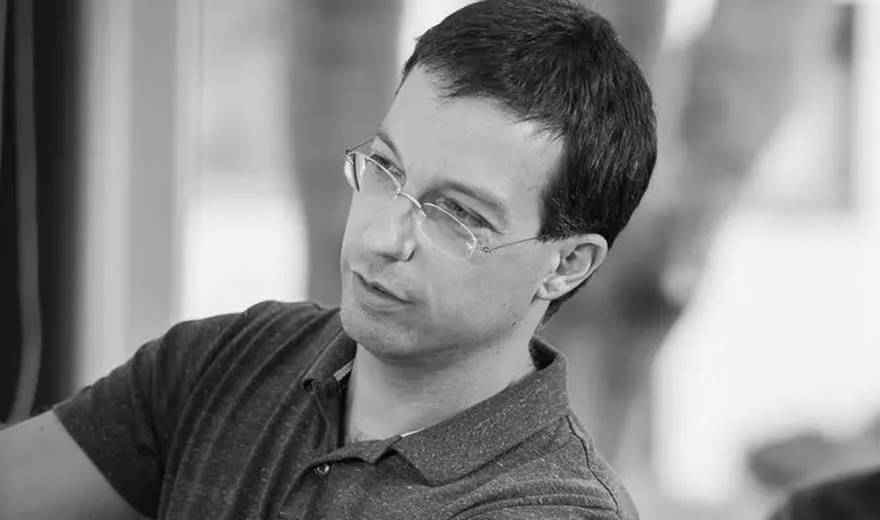
How did Martin come to ARCHEMED? The association’s founder is Dr. Peter Schwidtal, who was at the time the family doctor of one of Martin’s friends. That’s how the connection came about—rather by chance. Unfortunately, Martin’s friend passed away from leukemia—just one year after Martin’s second trip with him. From that point on, Martin took over all of his responsibilities and has successfully continued his work to this day.
The Project
While it was initially just curiosity and a thirst for adventure that brought Martin to Eritrea, he quickly fell in love with the country and its people.
Through his regular visits once a year, he has also formed wonderful friendships that continue to this day.
His first stop is always Asmara, the capital of Eritrea. In the surrounding area, there are several towns where he has already been active, supporting the people by setting up sterilizers.
This year, he is overseeing a project in Keren, the country’s second-largest city. Thanks to his work on the ground, invasive procedures using sterile instruments are now possible, and he is thus contributing to the safety of both patients and the doctors treating them.
What may sound fairly unspectacular at first glance is, in reality, associated with several fundamental challenges. A persistent issue is the basic supply of electricity and water, as these resources are becoming increasingly scarce. To distribute the available electricity evenly, it is allocated to a different neighborhood each day—which also means that at night it is so dark you can’t see your feet on the ground; the more rural the area, the worse the situation becomes.
“As a European, it’s hard to even imagine, because we have so much light pollution!” says Martin Plöger.
But it’s not just the lack of electricity and water that makes providing support on the ground difficult; bureaucracy also requires patience. For example, only locals are allowed to buy SIM cards for internet access, and even the registration of a small van has been stalled for six years now, since it would only be approved with restrictions, making its use virtually impossible.
But what drives Martin to embark on this journey again and again?
During his stays, he also repeatedly experiences many wonderful things, such as spending the night on the beach on an uninhabited island in the Dahlak Archipelago in the Red Sea, or participating in events and visiting places that a European would never otherwise get to see—experiences he will never forget.
His two children have also had the pleasure of visiting the area. His son even learned to drive there (at just 16 years old). Thanks to the open and warm nature of the Eritreans, they quickly made friends with kids their own age and spent the whole day out and about with them. Martin is proud to say that his daughter and son would come back with him anytime, because their time there was unforgettable for them, too.
It is these experiences that help him get through the less positive moments. The moments when children with heart conditions have to be turned away because the doctors’ screening has shown that their chances of survival are too low to make surgery worthwhile—since help is only provided, or can even be provided at all, when the prognosis is good. Or the moments when children with diabetes cannot be treated because there is simply no way to refrigerate the necessary medications in their villages.
All these experiences, challenges, and successes are what motivate Martin to want to make a difference and keep him flying back to Eritrea time and again. It wasn’t easy for him to condense the many experiences from the past years into a short text or an interview—because there is still so much more to tell. The same goes for selecting the photos, as there are hundreds of them, each telling a different story or depicting a different life.
When asked what people can do to support him, he replies quite modestly that it’s enough for the organizations, sponsors, and supporters to continue treating him with such positivity and goodwill. Yet another thing that makes Martin, his project, and his dedication even more endearing.
Your Partner for Quality, Safety, and Compliance
The life sciences sector requires specialized knowledge and reliable support. With our comprehensive expertise, we help companies comply with laws and regulations, ensure quality, and continue to innovate with confidence.
Related Services
Related Articles
18 Jun 2026
19%—a fee you’ll never have to pay again.
Normec Hybeta’s hygiene services are exempt from sales tax under the applicable legal requirements. Not a discount. Not a special offer. But a structural advantage that extends across your entire facility—from operating rooms to water and air hygiene to hospital hygiene.
01 Apr 2026
Cleanrooms at Medical Device Manufacturers
Commissioning • Monitoring • Requalification
10 Mar 2026
Validation of New Reprocessing Devices – Your Operator Obligations Under the MPBetreibV.
New reprocessing devices (RDG, RDG-E, sterilizers) may only be put into routine operation once their processes have been validated in accordance with the law. The MPBetreibV defines clear requirements for this and specifies who is authorized to perform this validation. An independent, accredited testing laboratory lays the foundation for safe and legally compliant operation from the very first use.
10 Mar 2026
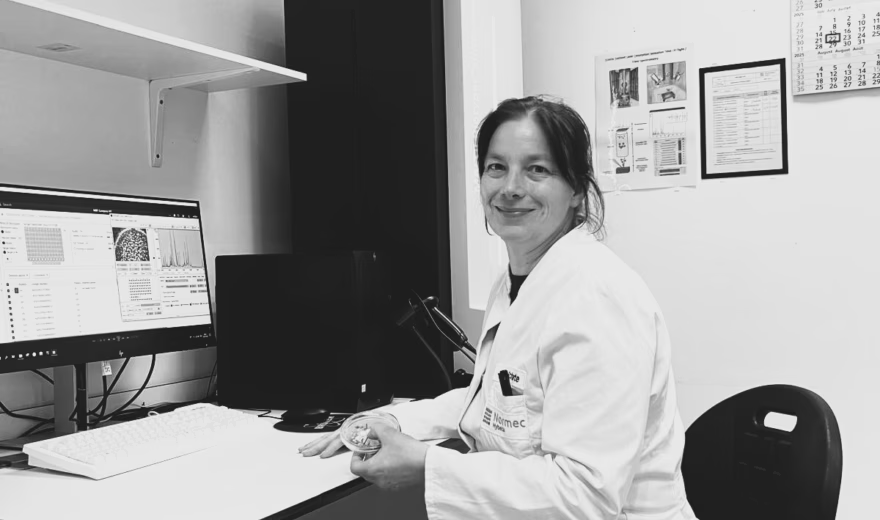
"A great way of interacting with each other—the friendliness and willingness to help one another"
Tatiana Pershukova (37) is a team assistant in the Technical Hygiene and Construction department. In this interview, she talks about her work experience at Normec Hybeta.
10 Dec 2025
Your specialist for microbiological and technical hygiene in the healthcare sector
We are pleased to announce that the identification of microorganisms using the MALDI Biotyper® is now also available through us under an accredited framework (D-PL-17310-01-01) in accordance with DIN EN ISO/IEC 17025:2018!
17 Jun 2025
Normec Hybeta announces:
Hygiene Requirements for the Reprocessing of Thermolabile Endoscopes – Flush-Brush-Flush and the “New” Annex 8
14 Mar 2024
February 29, 2024—a day to celebrate volunteerism!
Two weeks ago today was the day—this year, February gave us an extra day. To make good use of the extra time, we at Normec Hybeta decided to join “Social Day 2024.”