



Legislation
The United States (US) Federal Drug Supply Chain Security Act (DSCSA) is a federal law enacted in 2013 by the Food and Drug Administration (FDA) with the aim of improving the safety and traceability of medicines in the U.S. supply chain. This enables the U.S. government to protect its citizens from counterfeit drugs, stolen drugs, and other potentially dangerous drugs that may be circulating in the supply chain.
The FDA gave pharmaceutical manufacturers, distributors, repackagers, and dispensers (pharmacies and hospitals) a 10-year period to comply with the DSCSA requirements through a progressive, phased approach, with a deadline of November 27, 2023. However, in August of last year, a one-year extension was granted to the pharmaceutical industry, pushing the final implementation deadline to November 27, 2024. This one-year stabilization period is intended to accommodate the additional time all parties need to refine and stabilize their processes and systems.
Requirements
The DSCSA requirements for the pharmaceutical industry can be divided into four pillars:
1. Product Identification
This pillar encompasses the principles of serialization and aggregation.
Serialization:
= The unique identification of individual units (medication packages) using assigned serial numbers. These serial numbers are printed on the package along with the product code, lot number, and expiration date, as well as the 2D matrix containing this information.
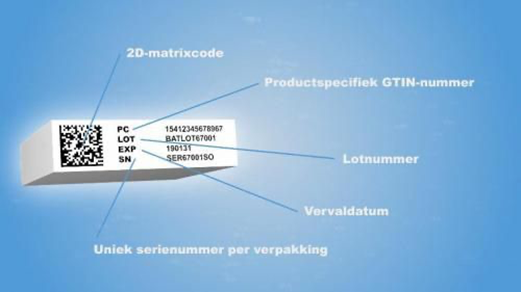
Aggregation
= Using serial numbers to link an individual unit (medication package) to higher-level packaging units further down the supply chain (cases and pallets). This establishes hierarchical relationships and ensures the exact contents of a case or pallet are known.
To comply with DSCSA requirements, at least “unit-to-case” aggregation is required. However, most pharmaceutical manufacturers choose to also implement “case-to-pallet” aggregation so that processes further down the supply chain can run more efficiently. This way, when a pallet is received, the pallet label can be scanned, and the pallet does not need to be opened to scan the labels on the individual units or cases.
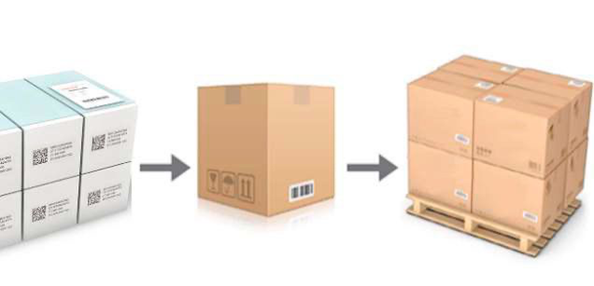
2. Product Verification
Product verification is based on the principle of vertical reporting. The DSCSA stipulates that a returned, intact medication package may only be resold if its authenticity has been verified in advance. The method by which this must be done is not specified. The pharmaceutical industry has decided that each pharmaceutical manufacturer must upload the product-specific data (serial number, GTIN, lot number, expiration date) for each medication package to its “Verification Router Service” (VRS). Distributors and dispensers further down the supply chain can, if they are subscribed to the VRS, use this service to verify whether the data on the medication package matches the data uploaded to the VRS. If a distributor or dispenser is not subscribed to the VRS, they can contact the manufacturer directly to verify the data on the package.
3. Tracing
Tracing is based on the principle of “transfer of ownership” and horizontal reporting. The specific data for each individual medication package is transferred from one step in the supply chain to the next, from the manufacturer all the way to the dispenser. Shipping and transport information is also shared in this process. This allows for a complete picture of the path the medication package has taken through the supply chain. If a medication package is suspected of being counterfeit, this information can be used to investigate where the suspicious package entered the supply chain. It is important to note that this complete set of information must only be made available if an investigation into a suspicious medication package is necessary following a complaint from one of the “authorized trade partners,” the FDA, or the “State Board of Pharmacy,” or during process audits by the authorities.
4. Authorized Trade Partner
A manufacturer may only sell drugs to distributors and dispensers with a valid license. In turn, distributors and dispensers may only purchase drugs from manufacturers and distributors, respectively, with a valid license. It is up to the manufacturers, distributors, and dispensers themselves to verify that their partners hold such a license.
Conclusion
Just as with the implementation of the European serialization requirements, the implementation of the DSCSA entailed a great deal of work for pharmaceutical companies. The primary goal of both pieces of legislation is the same: to ensure the integrity of the pharmaceutical supply chain, prevent the circulation of counterfeit medicines, and improve patient health and safety. The way in which the European Medicines Agency and the FDA intend to implement these requirements has similarities but also many differences, making this yet another significant challenge even for pharmaceutical companies that are already manufacturing in compliance with the European serialization guidelines.
Sources:
https://www.fda.gov/drugs/drug-supply-chain-integrity/drug-supply-chain-security-act-dscsa
Your partner in quality, safety, and compliance
The life sciences sector requires specialized knowledge and reliable guidance. Thanks to our extensive expertise, we help organizations comply with laws and regulations, ensure quality, and continue to innovate with confidence.
Related services


Related Articles


10 Jul 2026
Project Management
In the complex and highly regulated world of the pharmaceutical industry, project management plays a pivotal role to bring life-saving medications and treatments to the market. From drug discovery to clinical trials and regulatory approval, effective project management is essential for managing timelines, resources, and compliance. Let’s dive in some practical tips and tricks specifically for navigating the complexities of project management in the pharmaceutical sector.


10 Jul 2026
Potential Pitfalls in an MES Project
Just as every project has its pitfalls, the same is true for a Manufacturing Execution System (MES) implementation project. Implementing electronic batch records is no easy task. That’s why, in the blog below, we’ll share a few pitfalls so you can prepare for a successful implementation within your company.
10 Jul 2026
Streamlining Post-Marketing Surveillance with IMDRF Coding
Since the implementation of the Medical Device Regulation (MDR) in Europe, companies have had to maintain and execute a post-marketing surveillance (PMS) procedure. This systematic process involves collecting and analysing data on the performance and safety of medical devices after they have been released to the market. The primary goal is to help manufacturers identify and address potential issues that may arise during actual use, monitor the market for known risks, and identify new risks.
10 Jul 2026
ISO 9001:2015 in Life Sciences Industry
In the life sciences industry, maintaining high quality standards is critical not only to the success and sustainability of organizations but also to patient safety and compliance. ISO 9001:2015, part of the ISO 9000 family, provides a robust framework for quality management systems (QMS) that can be used in organizations in the life sciences, including pharmaceutical, natural technology, including medical devices. This article examines the key features of ISO 9001:2015, its benefits, implementation methods, potential pitfalls, and impact in the life sciences.
10 Jul 2026
The Role of a CQV Expert in the Cold Chain Division of a Pharmaceutical Company
In the pharmaceutical industry, product quality is of vital importance. This is particularly true for medicinal products that are sensitive to temperature fluctuations, such as vaccines, biologics, and certain medications that must be stored and transported in a controlled environment. Within this process, the CQV (Commissioning, Qualification, and Validation) expert plays a crucial role, especially within the cold chain division, which is responsible for monitoring product quality during the transport and storage of these temperature-sensitive products. This blog outlines the various aspects a CQV expert must consider in this context.
10 Jul 2026
Radiopharmaceutical & Selective Internal Radiation Treatments: Overcoming Challenges and Embracing Future Opportunities
Radiopharmaceutical and selective internal radiation treatments have emerged as a transformative force in the pharmaceutical industry, offering precision, personalized therapies for patients with conditions such as cancer and other serious diseases.
10 Jul 2026
Implementation of the European Clinical Trial Regulation (EU-CTR)
By the end of this month (31st of January 2025), the final deadline is reached in the transition period for the implementation of the European Clinical Trial Regulation (EU-CTR). What is it and what is the difference with the previous European Clinical Trial Directive (EU-CTD)?