



Technology transfer is the collaborative process for the directed dissemination of scientific findings, knowledge and intellectual property from the inventors to a receiving party. Specifically in pharmaceutical industry, it plays an important role within product life cycle management, from drug discovery to industrial scale pharmaceutical manufacturing.
Technology transfer can be put in place between different knowledge institutes/companies, or within a company, and this between the same or different phases in the pharmaceutical drug substance/drug product development (for example transfer between R&D – R&D, R&D – manufacturing, or manufacturing – manufacturing sites). The transfer can include also scale up / optimizations / any other changes (e.g. equipment design / materials (suppliers) / control strategy / …) of the process being transferred, and can involve differences in regulation (since the transfer can involve different countries).
In order to comply to all regulatory expectations, such as those described under the pharmaceutical quality management system, the technology transfer needs to be based on documented knowledge/experience and its successful completion needs to be evidenced at the receiving side in their ability to effectively perform and control all critical aspects of the transferred technology showing they are able to produce quality product consistently at the defined manufacturing scale. For this a systematic approach to technology transfer needs to be followed and approved by both parties, as described in a Technology Transfer (master) Plan. The general steps you will likely encounter during a technology transfer project are shown below and are discussed further in this blog.
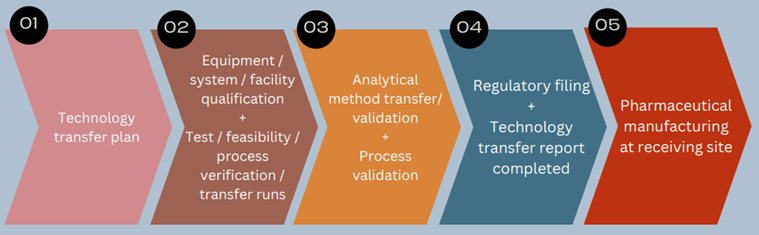
Step 01
The Technology Transfer Plan needs to give a detailed description of all documentation regarding the technology (product, process or procedure) in scope and the activities that need to be delivered/performed, along with a schedule, roles and responsibilities and acceptance criteria for the transfer from the perspective of both parties.
Below a handy checklist is provided of the documentation/knowledge a transferring site typically needs to have regarding the process and will need to provide and explain to the receiving site. The level that the information is defined/proven should be commensurate with the stage within product life cycle (it should be higher the later in the life cycle stage).

Apart for an approved comprehensive Technology Transfer Plan the success of the technology transfer will be greatly facilitated by setting up and continuously maintaining clear communication between the transferring (or sending) site and receiving site, preferably having a cross-functional project team at both sites dedicated to the technology transfer.
Changes, delays, failures, risks, findings,… with possible impact on any aspect in scope of the technology transfer should be openly communicated between both parties, in order to assess and if required implement correctly and in time the required mitigations/actions. Standard procedures should be in place to cover this.
An important part of the technology transfer is performing a technology transfer gap-fit assessment and based on it define control/mitigation actions to overcome any differences at the receiving site versus the transferring site. The assessment needs to include differences in intended batch sizes, premises, equipment, instruments, procedures, quality management, technical capabilities, qualification and validation expertise, personnel, health & safety and environmental regulations, materials, suppliers,…
Step 02
Before performing the process validation runs at the receiving site, it is required to complete the commissioning and qualification of the facility and equipment. And it is also likely needed to perform test / feasibility / process verification / transfer runs based on study plans in order to gather the required information on the impact of any change introduced along with the transfer, to allow for the assessment of improvements/optimizations, and to assess the overall process readiness at the receiving site.
Step 03
Since analytical methods are needed from the onset of the studies to provide data and demonstrate the results of the (comparability) studies, it is required to make sure their transfer and/or validation at the receiving site is included in the early phase of the technology transfer. This needs to span the testing needed on the input materials, in-process samples, cleaning samples and the end product(s) in accordance to their release specifications.
Successful transfer of the pharmaceutical manufacturing process will be evidenced by the successful completion of the assessed required number of process validation runs (in general 3 consecutive successful runs is accepted as the standard). Here the receiving site’s ability will be tested to perform and control the process consistently resulting in end product with the predefined quality attributes. Apart from process validation, cleaning validation, stability, hold-time, bioburden and extractable & leachable studies might be required to be done as well at the receiving site.
For the qualification and validation activities to be successful in addition to the criteria specific to the transfer, it is required to have a robust quality management system in place (which entails training management, deviation management, change management, risk management,…).
Step 04
The progress and success of the technology transfer needs to be monitored and reviewed throughout the project and at the end of the transfer a Technology Transfer Report should be made to conclude if the technology transfer has been successfully completed, by verify all activities and acceptance criteria as listed in the Technology Transfer Plan have been met, and/or any changes or deviations have been investigated and mitigated accordingly.
In conjunction with the regulatory affairs teams the technology transfer team will need to prepare the regulatory submission package, this is best planned early on so it is ready for submission soon after the completion of the process validation.
Step 05
After approval of the regulatory filling of the transferred process by the receiving site the commercial production can be initiated at the receiving site. From here the process is included in the site’s ongoing process validation and continuous improvement activities
Suggested further reading:
- Annex 4 WHO guidelines on technology transfer in pharmaceutical manufacturing
- PDA Technical Report No.65 Revised 2022 (TR 65) Technology Transfer
Relying on a partner that has experience with supporting technology transfers can prove to be a big factor in both the speed and successfulness of your company’s technology transfers. Farma Consulting & Partners can provide your company with consultants that can facilitate and/or lead your technology transfer projects, contact us today for more information!
Your Partner in Quality, Safety, and Compliance
The life sciences sector requires specialized knowledge and reliable guidance. Thanks to our extensive expertise, we help organizations comply with laws and regulations, ensure quality, and continue to innovate with confidence.
Related services


Related Articles


10 Jul 2026
Project Management
In the complex and highly regulated world of the pharmaceutical industry, project management plays a pivotal role to bring life-saving medications and treatments to the market. From drug discovery to clinical trials and regulatory approval, effective project management is essential for managing timelines, resources, and compliance. Let’s dive in some practical tips and tricks specifically for navigating the complexities of project management in the pharmaceutical sector.
10 Jul 2026
Potential Pitfalls in an MES Project
Just as every project has its pitfalls, the same is true for a Manufacturing Execution System (MES) implementation project. Implementing electronic batch records is no easy task. That’s why, in the blog below, we’ll share a few pitfalls so you can prepare for a successful implementation within your company.
10 Jul 2026
Streamlining Post-Marketing Surveillance with IMDRF Coding
Since the implementation of the Medical Device Regulation (MDR) in Europe, companies have had to maintain and execute a post-marketing surveillance (PMS) procedure. This systematic process involves collecting and analysing data on the performance and safety of medical devices after they have been released to the market. The primary goal is to help manufacturers identify and address potential issues that may arise during actual use, monitor the market for known risks, and identify new risks.
10 Jul 2026
ISO 9001:2015 in Life Sciences Industry
In the life sciences industry, maintaining high quality standards is critical not only to the success and sustainability of organizations but also to patient safety and compliance. ISO 9001:2015, part of the ISO 9000 family, provides a robust framework for quality management systems (QMS) that can be used in organizations in the life sciences, including pharmaceutical, natural technology, including medical devices. This article examines the key features of ISO 9001:2015, its benefits, implementation methods, potential pitfalls, and impact in the life sciences.
10 Jul 2026
The Role of a CQV Expert in the Cold Chain Division of a Pharmaceutical Company
In the pharmaceutical industry, product quality is of vital importance. This is particularly true for medicinal products that are sensitive to temperature fluctuations, such as vaccines, biologics, and certain medications that must be stored and transported in a controlled environment. Within this process, the CQV (Commissioning, Qualification, and Validation) expert plays a crucial role, especially within the cold chain division, which is responsible for monitoring product quality during the transport and storage of these temperature-sensitive products. This blog outlines the various aspects a CQV expert must consider in this context.
10 Jul 2026
Radiopharmaceutical & Selective Internal Radiation Treatments: Overcoming Challenges and Embracing Future Opportunities
Radiopharmaceutical and selective internal radiation treatments have emerged as a transformative force in the pharmaceutical industry, offering precision, personalized therapies for patients with conditions such as cancer and other serious diseases.
10 Jul 2026
Implementation of the European Clinical Trial Regulation (EU-CTR)
By the end of this month (31st of January 2025), the final deadline is reached in the transition period for the implementation of the European Clinical Trial Regulation (EU-CTR). What is it and what is the difference with the previous European Clinical Trial Directive (EU-CTD)?