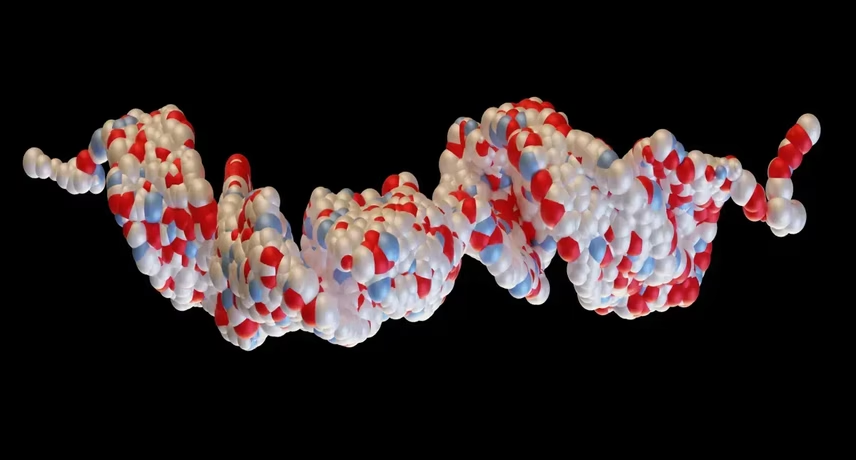

The complex structure of these drugs makes them difficult to separate and detect by conventional analytical methods. These drugs’ low stability means they can degrade or lose their activity during sample preparation, storage, or analysis. The high susceptibility to matrix interference means that the presence of exogenous or endogenous compounds in the biological samples can affect the accuracy and precision of the measurement. Therefore, there is a need for a sensitive, selective, and robust analytical method that can overcome these challenges and accurately quantify the peptides linked with payloads in plasma samples.
Solution
A liquid chromatography-tandem mass spectrometry (LC–MS/MS) method was developed to analyze a peptide linked with a warhead in rat, non-human primate (NHP), and human plasma. The method involved a simple protein precipitation step followed by chromatographic separation and detection using a triple-quadrupole mass spectrometer. A stable isotope-labeled peptide was used as an internal standard (IS) to correct for analyte losses and matrix effects.
The protein precipitation step was performed by adding acetonitrile to the plasma samples. This resulted in the precipitation of proteins and other interfering substances while retaining the peptide linked with the warhead and the internal standard in the supernatant. The supernatant was then injected into the LC–MS/MS system, where the peptide linked with the warhead and the internal standard (IS) were separated on a reversed-phase C18 column using a gradient elution of water and acetonitrile, both containing 0.1% formic acid.
Detection was performed by the mass spectrometer in the positive electrospray ionization mode (ESI+), using multiple reaction monitoring (MRM) of the precursor and product ions of the peptide linked with the warhead and the internal standard. The MRM transitions were optimized to achieve the highest sensitivity and specificity for the analyte and the internal standard. The developed workflow was designed to provide a robust, reproducible, and sensitive assay suitable for peptide quantification across multiple species and to support bioanalytical studies in both preclinical and clinical drug development.

Outcome
The peptide LC–MS/MS method was successfully validated according to the US FDA guidance for bioanalytical method validation. The assay demonstrated excellent linearity, accuracy, precision, selectivity, sensitivity, recovery, and stability for the peptide linked with the warhead in rat, non-human primate, and human plasma.
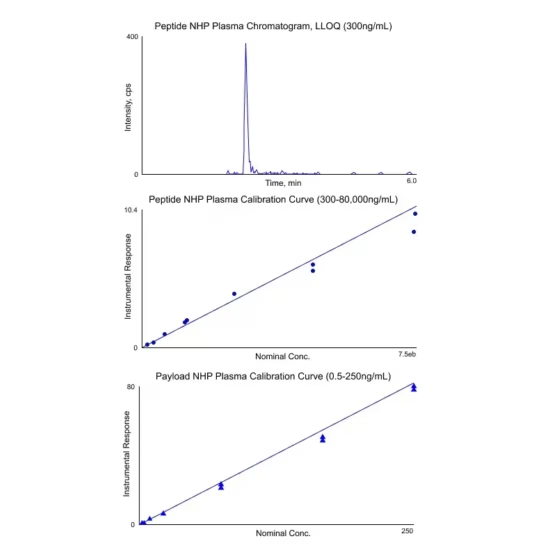
The calibration curves were linear over the 0.5–500 ng/mL concentration range, with correlation coefficients greater than 0.99. The accuracy and precision of the method were within the acceptance criteria of ±15% for the quality control samples and ±20% for the lower limit of peptide quantification. The method’s selectivity was demonstrated by the absence of any significant interference from blank plasma samples or plasma samples spiked with other drugs, including matrices from non-human primate studies.
The method’s sensitivity was sufficient to quantify the peptide linked with the warhead at the lower limit of quantification of 0.5 ng/mL. Recovery was consistent and reproducible, with values ranging from 85% to 95% for the peptide linked with the warhead and 90% to 100% for the internal standard. Stability was confirmed under a range of storage and handling conditions, including freeze–thaw cycles, short-term and long-term storage, and post-preparative storage, with no significant degradation observed.
The validated method was successfully applied to support pharmacokinetic studies in both preclinical and clinical settings. It demonstrated its utility and reliability for peptide quantification in plasma samples and provided valuable information for assessing the drug’s safety, efficacy, and pharmacological properties. In addition, the experimental LC–MS/MS strategy proved to be a robust platform for the quantitative analysis of peptides, proteins, and related metabolites, ensuring accurate and reproducible results across all study matrices.
Registered And Inspected By Various Regulatory Agencies
Speak To Our Scientist About Your Peptide Quantification, Peptide LC MS Analysis, Peptide PK
Related articles
MSD Hybridization ELISA PK Immunoassay Development, GLP Validation, And Oligonucleotide Analysis

TaqMan Gene Expression Assay, Copy Number Variation Assay Development, nGLP Validation, And Sample Analysis

Genomic Variation Analysis – TaqMan Single Nucleotide Polymorphism (SNP) Analysis

LC MS Bioanalysis Of Antisense Oligonucleotide (ASO) Using Mass Spectrometry And Ion Pair Chromatography

LC MS Method For Proline Amino Acid, Hydroxyproline In Mouse Tissues

LC MS Method For DNA Adducts Analysis In Cell-Based In-Vitro Samples

LC MS Method for Everolimus Eluting Coronary Stent Drug Delivery Systems

Mass Spectrometry Amino Acids, Quantitative LC MS Amino Acid Analysis

LC MS Method Development And GLP Validation For Human Plasma PK Sample Analysis

Incurred Sample Reanalysis (ISR) Test, FDA Requirements, And Study Evaluation
Dried Blood Spot (DBS) Sampling, DBS Collection, And DBS Analysis
Your partner in quality, safety, and compliance
The life sciences sector requires specialized knowledge and reliable support. With our broad expertise, we help organizations comply with laws and regulations, ensure quality, and continue to innovate with confidence.