

Due to their intrinsic and diverse nature, specific challenges are associated with ATMPs development:
- Regulatory complexity and risk-based approach
- Diverse manufacturing processes, sometimes complex
- Challenging Critical Quality Attributes
- Translational & Safety Challenges: no “one-fits-all” solution, and often lack of relevant animal models
- Clinical development is often on small populations, with ethical and operational barriers
However, ATMPs typically follow an accelerated development.
Regulatory Complexity
- Specific legislation in place: EU regulation EC1394/2007 – US FDA Regulation CFR 21 Part 1271
- Most current guidelines outline general principles to address the diverse nature of ATMPs. Developers must balance innovation with safety, relying on scientific rationale rather than strict adherence—essentially adopting a risk-based approach.
- National differences in legislations covering Genetically Modified Organisms (GMOs) and human-cells containing ATMPs.
Translational & Safety Challenges: no “one-fits-all” solution
- Non-clinical package for ATMPs is often incomplete – some studies are combined (e.g., toxicology and biodistribution) or not possible (metabolism and excretion). Additional safety studies might be needed, depending on the nature of the product (e,.g Immunogenicity, tumorigenicity).
- Many ATMPs are species-specific and lack relevant animal models, making it difficult to assess safety or efficacy in vivo before first-in-human studies.
- => Risk-based approach is the key.
Manufacturing & CMC
- Specific GMP guidelines: Eudralex Vol 4 part IV.
- Diverse manufacturing processes, sometimes complex, requiring specialized facilities and specific technical and scientific skills. Transitioning from small scale to GMP-compliant, reproducible production remains a major bottleneck.
- Defining Critical Quality Attributes (CQAs) is still challenging and standardization remains difficult. Full product characterization is not always possible given the nature of the product.
Clinical Trials Conduct
- Small populations: Rare disease indications limit recruitment; traditional randomized trials may be not feasible.
- Ethical and operational barriers: Irreversible interventions and limited comparators raise ethical challenges in trial design.
- Logistics challenges: Due to the nature of the product, requirement of perfect coordination. Specific technical skills and facility/ equipment might be needed.
However, ATMPs typically follow an accelerated development
- Agencies like EMA and FDA offer tailored Scientific advice programs to help navigate complex development.
- ATMPs often fit with designations associated with expedited programs (PRIME (EU), RMAT (US), Sakigate (Japan)).
- ATMPs are often eligible for Orphan Designation, providing market exclusivity and financial advantages.
- Non-clinical package tailored to the specific modality and indication can lead to shorter development time from academic to early clinical phases.
- Due to the nature of ATMPs and the shortage of patients, clinical phases can be combined, reduced, or, in some cases, skipped, leading to shorter development time from early clinical to commercial.
- However, long-term follow-up (up to 15 years), even post-approval is mandatory.
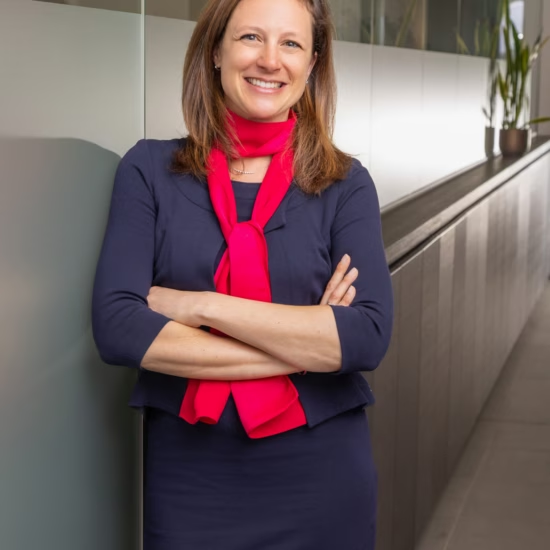
Meet the Authur - Sophie Vériter, PhD, Senior Consultant
I am excited to share my journey as a consultant in ATMP development with 2 Bridge.
As a scientist, I’ve always been driven by a passion for innovative therapies that improve health and quality of life. Over the past 10+ years, I have had the opportunity to contribute to the development of cell therapies, biologics, gene therapies and extracellular vesicles in regenerative medicine.
I was involved in the genesis of a promising Belgian biotech company, helping to translate research from the academic bench into cell therapy products now about to be tested in phase 2b/3 clinical trial. I led the discovery and preclinical development of novel therapies, including cell & gene therapies, and explored early R&D and CMC in extracellular vesicles.
Throughout my career, I have learned to thrive in fastpaced, dynamic environments where adaptability, creativity, and continuous improvement are essential.
Now at 2Bridge, I’m excited to bring this experience to support biotech innovators as they navigate the complex journey of ATMP development — from discovery to clinical translation.
I look forward to connecting and collaborating with others who share the same mission: transforming groundbreaking science into therapies that make a real difference for patients.
Your Partner in Quality, Safety, and Compliance
The life sciences sector requires specialized knowledge and reliable guidance. Thanks to our extensive expertise, we help organizations comply with laws and regulations, ensure quality, and continue to innovate with confidence.
Related services




Related Articles
18 Aug 2025
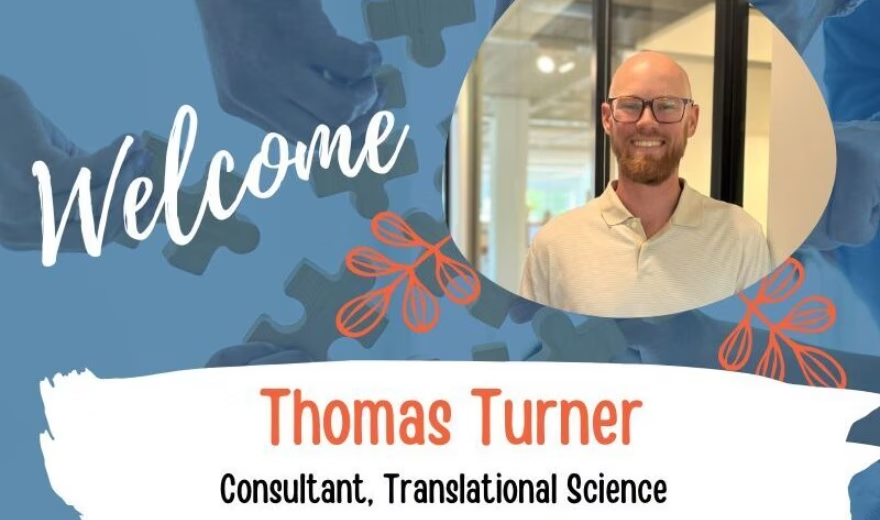
Welcome Thomas Turner
We’re delighted to welcome Thomas Turner, PhD to 2 Bridge as a Consultant – Translational Science.
25 Jun 2025
Welcome, Pieter Vaneynde
Pieter Vaneynde Associate Consultant, Quality
06 Jun 2025
The Clinical Lead: Turning Strategy into Patient-Ready Action
What to expect in this blog 1. The Role at a Glance 2. Their Key Responsibilities 3. What Makes a Strong Clinical Lead 4. A Closer Look at Their Impact
20 May 2025
Why Every Compound Development Team Needs a Project Leader
What to expect in this blog 1. The Visionary Behind Science Understanding the Role of Project Leaders 2. The Captain’s Mission Steering the Team towards Success 3. Navigating Rough Seas The Multi-tasks of the Project Leader 4. From Vision to Value Qualifications of a Drug Development Captain

14 May 2025
How Project Management Leaders Steer Tiger Teams in Drug Development
What to expect in this blog 1. The Maestro Behind the Scenes The Role of a Project Management Leader in a Tiger Team 2. Purpose Navigating the Complexity of Drug Development 3. Responsibilities Turning Strategy into Action 4. Skillset Communication and Collaboration 5. Conclusion The Compass of a Tiger Team
22 Apr 2025
Drug Development Is Not A Solo Mission
What to expect in this blog 1. Industrial pain and challenges Thriving but also challenging life science landscape 2. Why can’t you do drug development all alone Independent of the development stage your compound is in, it takes a ‘Tiger Team’ to rocket it to the next step 3. A dynamic and agile strategy to tackle the challenges In 2013, 2 Bridge is Born From NASA’s Tiger Team to drug development: How 2 Bridge aims for the moon in pharma innovation 4. Benefits of working with a Cross-Functional Tiger Team If you are a startup, you gain… If you are an investor, you benefit from…
18 Feb 2025
2 Bridge Receives Crédit d’Impôt Recherche (CIR) Accreditation
English Announcement 2 Bridge is pleased to announce that the French Ministry of Higher Education, Research, and Innovation has officially granted the company accreditation for the Crédit d’Impôt Recherche (CIR) for the years 2024, 2025, and 2026.