

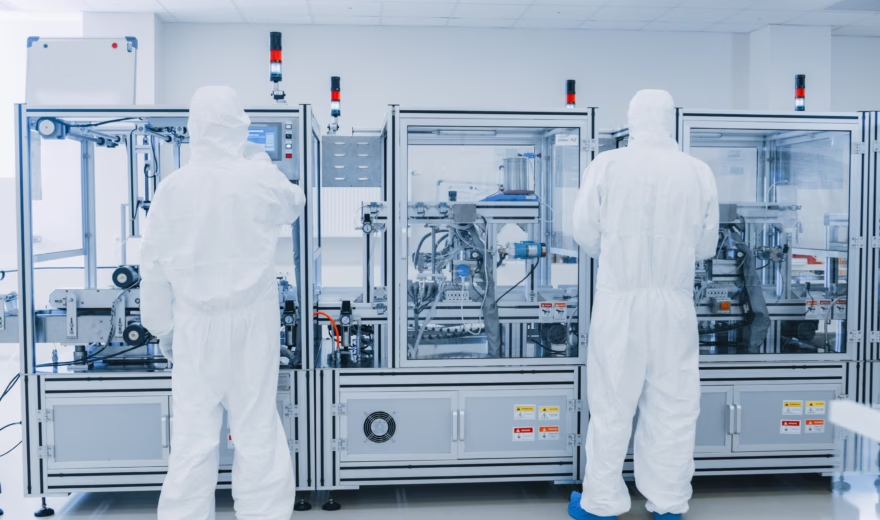
What is Oligo?
The expression of genetic material proceeds from DNA through RNA to proteins. Over the past century, efforts to develop new drugs have primarily focused on targeting proteins using various types of compounds, including small molecules and monoclonal antibodies. In this process, the drug influences the function of one or more specific proteins. However, not all types of proteins can be treated using this strategy.
An alternative to this traditional approach is the modulation of DNA or RNA. This can be achieved using oligonucleotides. Oligonucleotides are single- or double-stranded small synthetic nucleic acid polymers (≈20 or more nucleotides) with a known sequence. If this sequence is complementary to a specific segment of DNA or RNA—also known as an antisense oligonucleotide—it can then form a duplex with that segment and thereby inhibit gene expression. In this way, it influences the function of the protein.
Such an oligonucleotide process consists of the following steps:
- Synthesis: This is the chemical synthesis of relatively short fragments of nucleic acids with a defined chemical structure (sequence). To obtain the desired oligonucleotide, the building blocks (amidites) are sequentially linked to the growing oligonucleotide chain in the order required for the product’s sequence. This synthesis takes place in a column filled with a support.
- Cleavage & Deprotection: Once the sequence is complete, the product is eluted from the solid phase (= support), transferred to a solution, deprotected, and collected
- Purification: This crude oligonucleotide solution is then separated from impurities via chromatography
- Ultrafiltration / Diafiltration (UFDF): In this step, salts are removed from the oligonucleotides, and they are further concentrated.
- Annealing: In this optional step, one can choose to convert a single-stranded oligonucleotide into a double-stranded one through annealing
- Lyophilization: Finally, the excess water is removed via freeze-drying, yielding the final product
Upgrade to the Oligonucleotides Center of Excellence
To be able to produce oligonucleotides in-house that are suitable for toxicology batches or First-in-Human (FIH) clinical production, Janssen Pharmaceutica decided to upgrade its Oligonucleotides Center of Excellence and equip it with cGMP-compliant equipment. The goal of this Center is to expand internal capabilities and expertise to ensure the timely and reliable delivery of clinical products and to develop new processes.
Fit For Purpose
Since the focus of this process is solely on FIH purposes, it was decided to adopt a “streamlined” qualification approach, the Fit For Purpose (F4P) approach. The focus here is primarily on maximizing the use of FAT/SAT/commissioning tests, avoiding a strict separation of the various qualification phases, and reducing the number of QA reviews and approvals. This leads to a faster qualification process and significantly less paperwork and documentation.
Advipro’s Contribution
To successfully complete this large-scale project with ambitious timelines, the assistance of Advipro, among others, was enlisted. The A-team handled the compliance aspect for the equipment, utilities & facilities, as well as the execution systems (CSV).
Lien - Equipment
My role within the project initially focused on the equipment aspect of the project. A large number of mobile vessels, reactors, skids, etc., had to be procured, tested, and qualified. I was responsible for:
- Providing all qualification documents (URS/IA, protocols, reports, etc.). These were prepared based on the Fit For Purpose approach explained earlier. The biggest challenge here was determining what was and wasn’t required within the “Fit For Purpose” framework, as this was a new concept for everyone on the project team.
- Drafting the overarching Change Control and the various equipment-specific Change Controls. This also involved coordinating and reviewing/processing all CC actions (more than 1,000 actions).
As the “last woman standing,” it is currently my task to finalize the entire compliance component for the Oligo project, covering equipment, utilities & facilities, and execution systems.
Rani - Utilities & Facilities:
Within the project, I began by assisting Lien in drafting the qualification documents based on the Fit-for-Purpose Equipment Testing. I attended various FATs in the Netherlands for the mobile vessels used in the different stages of oligonucleotide production. My tasks included reviewing the documentation and conducting several functional tests. After a brief period of supporting the equipment component, I needed to shift my focus entirely to the Utilities & Facilities component of this project, which required a traditional qualification process. I was responsible for:
- Drafting all qualification documents (URS, IA, qualification and safety protocols, qualification and safety reports, etc.) in accordance with the two different methods used by the two responsible departments within Janssen Pharmaceutica.
- Developing the Utilities & Facilities-specific Change Controls
- Monitoring and coordinating the submission of evidence for these CC actions
I was able to hone my coordination skills within this project because I had to communicate with various contractors, the different departments within J&J, etc.
Kristof - Execution Systems
As a compliance engineer, I was primarily involved in the automation aspect of the project. Here, I gained familiarity with everything related to execution systems, PLCs, data integrity, and so on. For Oligo, we specifically used PCS7, the process control system responsible for, among other things, monitoring, visualization, and (in limited cases) direct control of equipment. PCS7 was involved in the change controls for many systems, which made it very complex. A full validation was required for PCS7. I was involved from the design review through to the functional testing. I primarily focused on documentation, such as drafting a URS, RA, and IOQP. I also had the opportunity to perform a number of functional tests related to data integrity myself.
Sara - Project Manager
During the Oligo project, I was the first person from Normec Advipro to join the project. I was involved in writing the project qualification plan and defining the approach that would be followed for compliance within the project. After the team was established, I systematically handed over my responsibilities to the team. In the project, I was responsible for the overall planning of compliance tasks and the budget for the entire Advipro A-team. On Normec Advipro’s side, we consistently remained flexible in providing the resources the project needed. I also monitored the team’s workload and stepped in when necessary.
And how did Janssen Pharmaceutica find working with a Class A Team?
“There was a real team spirit among the Normec Advipro members, and they integrated quickly into the project team. It was an exciting process in which the team was able to deploy resources flexibly and ensured the timely delivery and follow-up support of high-quality documentation. Project management was handled perfectly by this motivated team!”
- Jurgen Verbraeken, Senior Principal Engineer
Your partner in quality, safety, and compliance
The life sciences sector requires specialized knowledge and reliable guidance. Thanks to our extensive expertise, we help organizations comply with laws and regulations, ensure quality, and continue to innovate with confidence.
Related services







Related Articles
28 Apr 2026
A Failed APS: Every Sterile Production Department’s Nightmare
A failed aseptic process simulation (APS) is every sterile production department’s nightmare. As soon as the culture medium becomes cloudy, alarm bells go off throughout the entire organization.


16 Mar 2026
What do you know about EudraLex Volume 4 Annex 11:2026? Are your computer systems inspection ready?
The current version of Eudralex Volume 4 Annex 11 dates back to 2011 and is no longer fully up to date. The technological world has changed significantly since then. Requirements for lifecycle management and data integrity have become much stricter, and the use of cloud solutions in the pharmaceutical industry is now standard. Regulatory bodies such as EMA and PIC/S have indicated plans to revise Annex 11 to provide more clarity on its interpretation, guidelines for new technologies, and clear requirements for data integrity.
05 May 2025
Advipro Becomes Normec Advipro
Lille, May 5, 2025 – Advipro, an expert in consulting and project support within the life sciences sector, is taking a new strategic step. Starting in May 2025, the company will operate under the name Normec Advipro.


13 Sep 2024
Winter Mapping: Protect Your Temperature-Sensitive Products
Discover how mapping works and why it’s essential for addressing the challenges posed by controlled environments. We’ll outline the best practices for effective winter mapping.
31 Aug 2022
Where Can Normec Advipro Make a Difference? | PIC/S Standard
A new Royal Decree was recently published “concerning the preparation and dispensing of medicines and the use and distribution of medical devices within healthcare institutions.” You can read all about it in the blog “The New Regulations for Hospitals and Their Pharmacies.” Specifically, the regulations require work to be carried out in controlled environments (cleanrooms), where the handling of open containers must always take place in ventilated rooms with filtered air. For many hospitals, building and validating a cleanroom is a major undertaking, and they often lack the necessary in-house expertise. Collaborating with an expert like Normec Advipro offers enormous benefits. We work closely with the hospital and apply the “First Time Right” principle, which benefits the project’s quality, budget, and timeline. In the past, we’ve collaborated with various large and small hospitals, as well as university hospitals. Below, we outline a few project phases in which Normec Advipro provided real added value and share our three main lessons learned.


24 Feb 2022
5 Reasons to Choose a Career in Life Sciences
Choosing a career in pharma & life sciences is a forward-looking choice in a rapidly growing industry. But you must also make a conscious decision to enter this highly regulated and state-of-the-art sector.
24 Feb 2022
What is GxP?
Sooner or later, everyone comes into contact with medications, but we often don’t stop to think about everything that needs to be done to safely deliver a medication to the patient. When it comes to medications, patient safety is paramount. To ensure safety, various quality systems have been introduced in the pharmaceutical and food industries. These quality systems are divided into different categories. The general term for these quality systems is GxP. What does GxP mean, and why is it so important to implement quality systems in these industries?