


Chapter 1: Scope
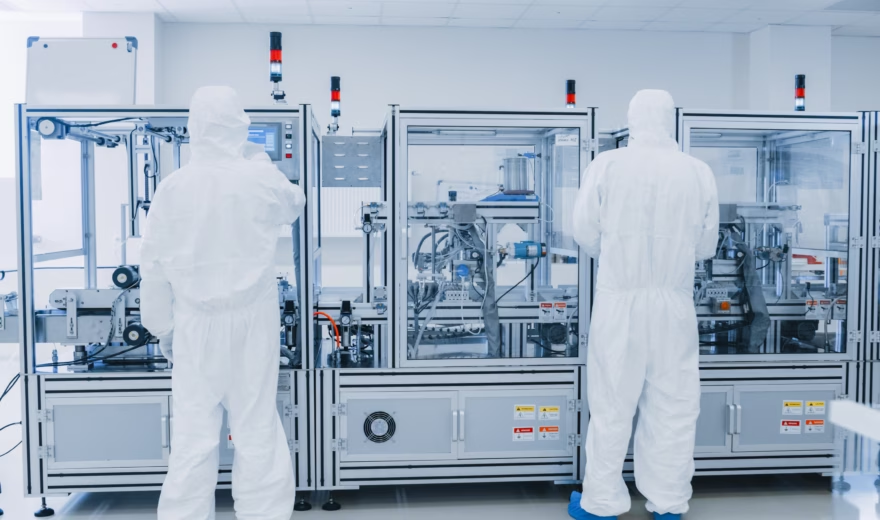
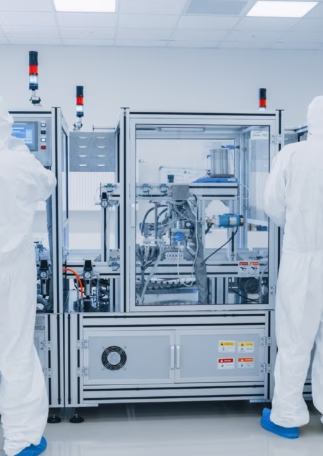
Chapter 1 explains that the guidelines were written for the production of sterile medicinal products but that they can also be used to support non-sterile production. This should not be misinterpreted; certain sections, such as gowning principles, are considered best practices for any cleanroom. Therefore, even if non-sterile production involves the use of cleanrooms classified as Class A through D, these areas must comply with the principles of Annex 1.
Chapter 2: Principles
This chapter outlines the general principles underlying Annex 1. It emphasizes three principles:
- Since personnel are a major source of contamination, processes must be automated wherever possible.
- All processes, equipment, utilities, and manufacturing activities must be conducted in accordance with the principles of quality risk management ( QRM).
- A contamination control strategy ( CCS) must be developed that identifies all possible sources of contamination and outlines the methods for mitigating or controlling such contamination.

Chapter 3: Pharmaceutical Quality System (PQS)
This chapter emphasizes the importance of quality systems. It outlines specific requirements for sterile manufacturing that ensure all activities are controlled and the risk of contamination is reduced:
- There must be a risk management system that covers the entire product lifecycle with the goal of minimizing contamination.
- The manufacturer must have sufficient knowledge of the product and the processes.
- In the event of failures, a root cause analysis must be conducted, followed by the development of appropriate CAPAs.
- The CCS is based on risk management.
- Management must be involved in monitoring and reviewing the risk management system.
- The processing, storage, and transport of the product must not cause contamination.
- Those responsible for batch release must have access to production and quality information. They must also have knowledge of the process so that errors can be detected.

Chapter 4: Premises
Chapter 4 specifies the expectations regarding the design of cleanrooms. To minimize contamination from materials and personnel, several new requirements are proposed. Among other things, this makes the use of Restricted Access Barrier Systems (RABS) and isolators mandatory in new facilities. Furthermore, there must be a unidirectional process for transferring materials into and out of Grade A and B areas, and the entry and exit changing rooms for Grade B must be separate.
Another important part of the changes in this chapter concerns the qualification of cleanrooms. The new guidelines for this are in accordance with ISO 14644. Key changes include:
- Videos of smoke studies must be included in the validation report.
- Cleanroom qualification must be performed “at rest” and “in operation.”
- Requalification of Grade A and B cleanrooms must be performed every 6 months; requalification of Grade C and D cleanrooms every 12 months.
Furthermore, cleaning and disinfection must be performed according to a written, validated procedure. Disinfection with sporicidal agents must be performed regularly.
Chapter 5: Equipment
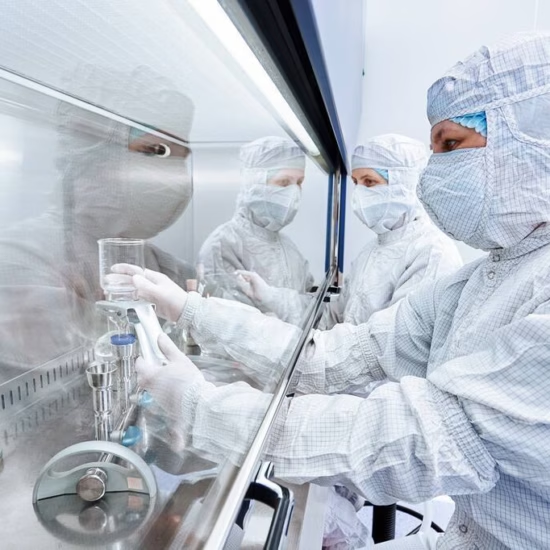
Chapter 5 describes how equipment and processes are properly described, qualified, and documented. Emphasis is placed on the importance of cleaning equipment and how equipment should be used in cleanrooms. Parts that come into direct or indirect contact with the product must be sterilized. Alarms must also be evaluated for trends.
Chapter 6: Utilities
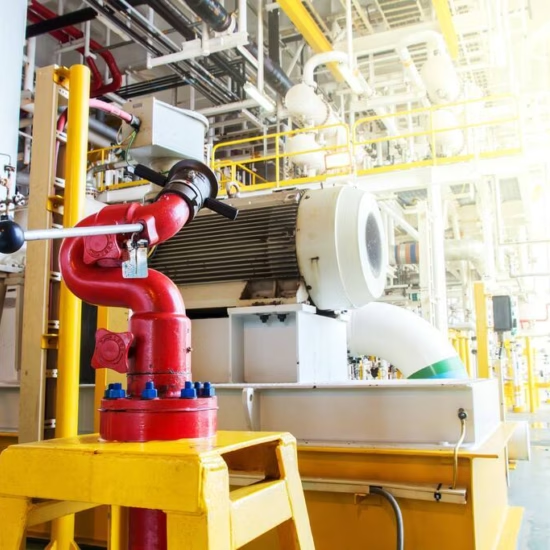
Chapter 6, which focuses on utilities, is almost entirely new. Guidelines have been formulated for four utilities: water for injection (WFI), pure steam, compressed gases (compressed air and nitrogen), and heating and cooling systems.
Some key guidelines in this chapter are:
- WFI systems must be continuously monitored for Total Organic Carbon (TOC) and conductivity.
- Gases that come into contact with the product must be monitored at every point of use.
- Heating and cooling systems must be located outside the cleanroom whenever possible.
Chapter 7: Personnel
This chapter outlines the guidelines for personnel, gowning, and training.
Compared to the previous Annex 1, greater emphasis is placed on the training and qualification of operators. In the event of trends in personnel monitoring or a failed media fill, an operator may be denied access to the cleanroom until he has been requalified.
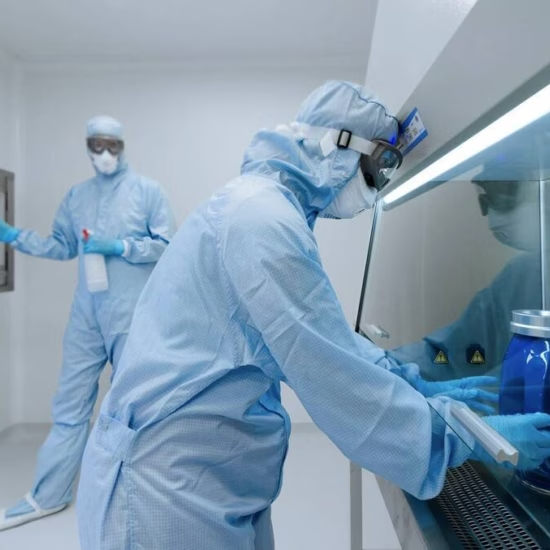
There are also new specifications for gowning. For example, operators must wear company-issued clothing (including socks) before entering the changing areas. For reusable clothing, “laundry” procedures must be qualified. In addition, the maximum number of times clothing may be worn is specified.
Chapter 8: Production and Specific Technologies
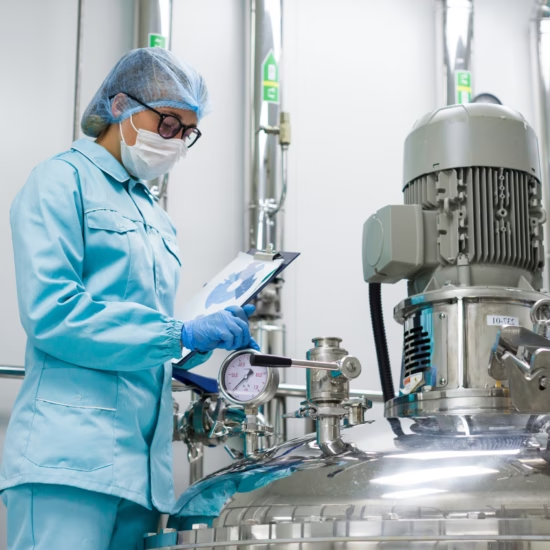
Chapter 8 sets out the guidelines for sterile production and related technologies. A maximum hold time must be determined for each aseptic step. More details have also been added to the requirements for “pre-use post-sterilization integrity tests” (PUPSIT).
The chapters on sterilization and blow-fill-seal have been significantly expanded, and new chapters have been added on form-fill-seal, freeze dryers, and single-use systems (SUS).

Chapter 9: Environment and Process Monitoring
This section of Annex 1 outlines how cleanrooms must be monitored and how this must be documented. Environmental monitoring consists of particle counts, microbial monitoring, monitoring of environmental parameters, and media fill. The guidelines for environmental monitoring have been significantly expanded. Important changes include:
- Greater emphasis is placed on trend analysis.
- Personnel monitoring must be performed during every critical intervention and each time personnel exit a Grade B area.
- The microbial limits for Grade A cleanrooms have been clarified to “no growth.”
- If microbial growth is detected in a Grade A cleanroom, an investigation must be initiated.
- The use of rapid analysis techniques for microbial sampling is recommended.
- For media fills, at least 5,000–10,000 vials must be filled, and any growth must result in a failed media fill and an investigation.
Chapter 10: Quality Control (QC)
The final chapter covers quality control. This chapter reiterates that personnel must be adequately trained and have sufficient experience with the processes, and it specifies the requirements for a product’s sterility testing.
The GxP Academy’s training courses have been updated with the latest information from Annex 1. Many sections of the new Annex 1 therefore have a direct impact on the operational management of a cleanroom. Think, for example, of the QRM, CCS, cleanroom classifications, etc. Advipro can also provide support in implementing the new Annex 1 through its various areas of expertise.Be sure to check out our GxP Academy website and the Advipro website:Training (gxp.academy) Solid support for production processes || Normec Advipro
Your partner in quality, safety, and compliance
The life sciences sector requires specialized knowledge and reliable guidance. Thanks to our extensive expertise, we help organizations comply with laws and regulations, ensure quality, and continue to innovate with confidence.
Related services






Related articles
28 Apr 2026
A Failed APS: Every Sterile Production Department’s Nightmare
A failed aseptic process simulation (APS) is every sterile production department’s nightmare. As soon as the culture medium becomes cloudy, alarm bells go off throughout the entire organization.


16 Mar 2026
What do you know about EudraLex Volume 4 Annex 11:2026? Are your computer systems inspection ready?
The current version of Eudralex Volume 4 Annex 11 dates back to 2011 and is no longer fully up to date. The technological world has changed significantly since then. Requirements for lifecycle management and data integrity have become much stricter, and the use of cloud solutions in the pharmaceutical industry is now standard. Regulatory bodies such as EMA and PIC/S have indicated plans to revise Annex 11 to provide more clarity on its interpretation, guidelines for new technologies, and clear requirements for data integrity.
05 May 2025
Advipro Becomes Normec Advipro
Lille, May 5, 2025 – Advipro, an expert in consulting and project support within the life sciences sector, is taking a new strategic step. Starting in May 2025, the company will operate under the name Normec Advipro.


13 Sep 2024
Winter Mapping: Protect Your Temperature-Sensitive Products
Discover how mapping works and why it’s essential for addressing the challenges posed by controlled environments. We’ll outline the best practices for effective winter mapping.
31 Aug 2022
Where Can Normec Advipro Make a Difference? | PIC/S Standard
A new Royal Decree was recently published “concerning the preparation and dispensing of medicines and the use and distribution of medical devices within healthcare institutions.” You can read all about it in the blog “The New Regulations for Hospitals and Their Pharmacies.” Specifically, the regulations require work to be carried out in controlled environments (cleanrooms), where the handling of open containers must always take place in ventilated rooms with filtered air. For many hospitals, building and validating a cleanroom is a major undertaking, and they often lack the necessary in-house expertise. Collaborating with an expert like Normec Advipro offers enormous benefits. We work closely with the hospital and apply the “First Time Right” principle, which benefits the project’s quality, budget, and timeline. In the past, we’ve collaborated with various large and small hospitals, as well as university hospitals. Below, we outline a few project phases in which Normec Advipro provided real added value and share our three main lessons learned.

24 Feb 2022
5 Reasons to Choose a Career in Life Sciences
Choosing a career in pharma & life sciences is a forward-looking choice in a rapidly growing industry. But you must also make a conscious decision to enter this highly regulated and state-of-the-art sector.
24 Feb 2022
What is GxP?
Sooner or later, everyone comes into contact with medications, but we often don’t stop to think about everything that needs to be done to safely deliver a medication to the patient. When it comes to medications, patient safety is paramount. To ensure safety, various quality systems have been introduced in the pharmaceutical and food industries. These quality systems are divided into different categories. The general term for these quality systems is GxP. What does GxP mean, and why is it so important to implement quality systems in these industries?