



What is PUPSIT?
In recent years, there has been much discussion about the need for pre-use/post-sterilization integrity testing (PUPSIT) for sterilization filters to detect damage before the filters are used. The rationale behind PUPSIT versus a single post-use filter test is that there is a possibility a filter could pass the post-use test but may have allowed microorganisms to pass through during the sterile filtration process itself. This phenomenon is called “filter flaw masking”: it means that damage to the filter—caused, for example, by the sterilization process itself—allows microorganisms to pass through, but the damage is subsequently sealed during the filtration process so that the filter can successfully pass the post-use test. For this masking phenomenon to occur, two conditions must be met:
1) There must be a defect in the filter that is large enough to allow bacterial penetration but small enough to become clogged during filtration;
2) The product being filtered must be able to block that defect to such an extent that the filter successfully passes the test after use.
Although the concept of PUPSIT appears theoretically sound, it also has drawbacks that might well outweigh the benefits.
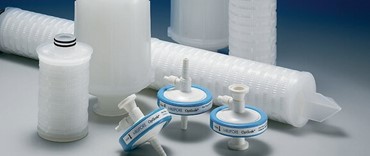
Figure 1: Examples of sterile filters (via www.merckmillipore.com)
Annex 1 on PUPSIT
The previous version of Annex 1 (2008) states the following regarding pre-use filter testing:
“113. The integrity of the filter must be checked before use and confirmed immediately after use via a suitable method such as a bubble point, diffusive flow, or pressure hold test. The time required to filter a known volume of bulk solution and the pressure difference that must be applied across the filter must be determined during validation, and any significant deviations from these values during routine production must be documented and investigated. The results of these checks must be included in the batch record. The integrity of critical gas and vent filters must be verified after use. The integrity of other filters must be verified at appropriate intervals. “
Because of this wording, it was easy for sterile manufacturers to feel compliant with regard to the pre-use testing requirements, namely by testing the filter offline before use and thus before sterilization. Even in the case of single-use filters, which are treated with gamma irradiation, manufacturers could consider themselves compliant by relying on the filter supplier’s certification for pre-use testing. However, this certification does not cover damage that could occur during shipping, receipt, and on-site storage, as well as during handling and installation by the end user. The recent update to Annex 1 (2022), however, leaves little room for interpretation, although it also acknowledges that the use of PUPSIT is not always feasible and that an alternative approach in the form of a risk assessment is permitted:
“8.87 The integrity of the sterilized filter must be verified prior to use by means of a pre-use post-sterilization integrity test (PUPSIT) to check for damage or loss of integrity caused by preparing the filter for use. A filter used to sterilize a liquid must undergo a non-destructive integrity test after use before the filter is removed from its housing. The integrity test process must be validated, and the test results must correlate with the filter’s microbial retention capacity, as determined during validation. Examples of tests used include bubble point, diffusive flow, water intrusion, and pressure hold tests. It is recognized, however, that PUPSIT is not always possible after sterilization due to process limitations (e.g., filtration of very small volumes of solution). In these cases, an alternative approach may be considered, provided that a thorough risk assessment has been conducted and that the requirements are met by implementing appropriate controls to mitigate any risks associated with a non-integrity filtration system.”
In addition, several points are specified that manufacturers must take into account during such a risk assessment. These include process knowledge, knowledge of the specific product type, and the product’s potential to mask the filter. In addition, factors such as the filter’s supply chain and the sterilization process itself must also be taken into account.
Flaw Masking Studies
Studies were conducted to determine whether and under what conditions so-called filter flow masking can occur. These studies enable the industry to better understand filter flaw masking and thus provide the knowledge necessary to correctly perform the required risk assessments, as outlined in the recent update to Annex 1.
In these studies, worst-case scenarios were simulated in which cartridge filters with marginal defects (obtained from filter production lines) were masked with protein-like solutions to cause the filter to pass the post-use integrity test. An important point to keep in mind is that these circumstances are rare, as most rejected filters have catastrophic defects (major defects that prevent the filter from being tested for integrity). Furthermore, marginal defects can still potentially block bacterial passage completely. The results show that out of 24 tested filters—which were tested with a contaminant concentration of 24 g/L and a flow rate reduction of 90% or more—only 2 filters exhibited “masking” (= failed the pre-use test but passed the post-use test). In another series of experiments, disc filters were used with defects created by drilling 10 µm laser holes. For these filters, an automated integrity tester was able to detect all damaged filters at every clogging level up to 75%.
The data collected from these masking studies clearly demonstrate that, while there is a change in the masking level, it is unlikely that this change would occur under routine conditions during pharmaceutical production. Only liquids with unusually high concentrations of contaminants, combined with atypical filter usage (e.g., very long filtration times), can lead to levels that approach an increased risk of masking. However, this will most likely also result in an excessive decline in flow rate, which is not feasible. Therefore, the assessment of product characteristics and flow decay are crucial parameters for manufacturers when evaluating the need for PUPSIT.
Bacterial Challenge Test Data Mining Study
The minimal risk of filter masking in the pharmaceutical industry was also demonstrated by a Bacterial Challenge Test (BCT) data mining study. This study was based on the concept that any liquid with the potential to cause clogging should also result in an increase in the bubble point value due to this excessive clogging of the pores. In other words, the ratio between the bubble point of the post-use test and the pre-use test can indicate whether a liquid is present that could mask weak spots.
To translate this concept to the industry, the authors used historical integrity test results from more than 2,000 filters used in BCTs to evaluate whether a bubble point inflation mechanism—and thus a risk of flaw masking —exists for a given fluid-and-filter combination. As with the flaw-masking studies, the results of these BCTs represent the worst-case scenario, since the sterilization-grade filters (0.2 µm) are exposed to product, plus a high concentration of the bacterial organism, which contributes to pore clogging and a potential flaw-masking effect. Parameters such as filtration duration, volumes, and flow rate were also typically set to very worst-case conditions during BCTs compared to the process being validated. In parallel with the BCT of the sterilization filters, a filter with a larger pore size (usually 0.45 µm) is typically tested as a positive control to confirm that viable and sufficiently small bacteria are being used that can penetrate the filter. These filters, which are also tested before and after use, have lower bubble point results due to their larger pores and can be considered a model for filters with marginal defects. If the 0.45 µm filter becomes so contaminated that the post-use result exceeds the sterilizing filter’s minimum breakthrough value of 0.2 µm, masking of defects would pose a risk for this fluid/filter combination.
The results of the data mining study showed that the average ratio between the post-use bubble point test and the pre-use bubble point test was 1.00 ± 0.15, indicating that there is generally no trend toward bubble point inflation within the industry. When examining individual fluid/filter combinations, the data mining team found that only a small proportion (1.5%) of the filter test conditions showed ratios indicating a theoretical risk of masking. Despite the low percentage, the actual risk is likely even lower, as BCTs are conducted under the worst-case conditions and with a substantial addition of bacteria. Furthermore, this study also demonstrates that the BP ratios observed during routine bacterial retention tests provide a way to assess the risk of masking for specific fluid/filter combinations and can therefore be taken into account when determining whether a PUPSIT should be implemented.
Risks of PUPSIT
As mentioned earlier, there has been much debate regarding the implementation of PUPSIT because it can also—and this may sound controversial—introduce risks into the sterile manufacturing process. The main drawback of integrating PUPSIT into a filtration process is the increased complexity of the process, especially for redundant filtration systems (see Figure 2). This increased complexity comes with additional risks and drawbacks that must be taken into account before implementing PUPSIT. The most common drawbacks are:
- To perform an in-line filter integrity test, the system must maintain a much higher pressure, often exceeding 60 psi. This increases the risk of sterile leaks, especially when using single-use equipment, which often employs weaker connections/valves compared to stainless steel piping. The greater number of valves and flushing bags/containers also contributes to this increased risk of leaks.
- Wetting the filter with buffer, which is necessary to perform the pre-use test, can lead to dilution of the final product unless the filter is dried or the first volume is discarded.
- Longer process times due to the need for additional steps such as filter wetting, drying, and the need to adapt to non-standard situations such as re-wetting the filter. In addition, all additional protective aeration filters supplied with PUPSIT systems must be tested.
- The need for system manipulation (e.g., opening/closing valves) on the sterile side of the filter, making the PUPSIT system more vulnerable to human error. It should be noted, however, that this risk can be eliminated through the use of automated systems.
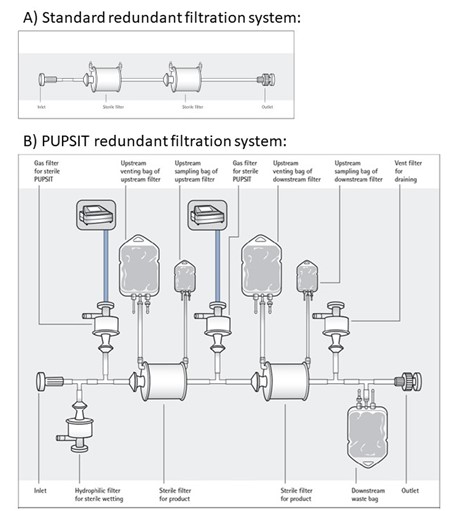
Figure 2: Schematic overview of non-PUPSIT systems (A) and PUPSIT systems (B), illustrating the complexity of PUPSIT for redundant filtration (source: www.pda.org)
Your partner in quality, safety, and compliance
The life sciences sector requires specialized knowledge and reliable guidance. Thanks to our extensive expertise, we help organizations comply with laws and regulations, ensure quality, and continue to innovate with confidence.
Related Services


Related Articles


10 Jul 2026
PUPSIT (Part 2 of 2)
Despite my relatively short QA career in aseptic pharmaceutical manufacturing, I have had the opportunity to work with both PUPSIT and non-PUPSIT filtration systems at multiple production sites. This has given me a good understanding of the advantages and disadvantages of PUPSIT in practice.
10 Jul 2026
Handling of Out of Specification (OOS) results
As described in cGMP regulations (21 CFR 211.160 & 211.165), laboratory testing of components, containers & closures systems, in-process materials, bulk- and finished products is mandatory to ensure product quality and patient safety.
10 Jul 2026
The Fight Against Counterfeit Medicines – U.S. Edition
A few months ago, our consultant Clara wrote a blog post about serialization and the fight against counterfeit medicines. She explained the principle of serialization for medicines distributed on the European market and cited Ozempic as an example. In this blog, our consultant Esther will take a closer look at the serialization requirements across the Atlantic, specifically in the United States.
10 Jul 2026
Qualification of Suppliers – excipients
The quality, efficacy and safety of the medicinal product depends on many factors of which we’ve already tackled a few in previous blog posts. The one we will be talking about this time is supplier qualification of excipients.
10 Jul 2026
Technology Transfer in Pharmaceutical Manufacturing
In this blog, a high-level introduction is given with respect to technology transfer in pharmaceutical manufacturing.
10 Jul 2026
Internal audits
Internal audits—sometimes referred to as self-inspections—are a crucial part of any quality management system (QMS). Nevertheless, they are sometimes viewed merely as a necessary evil to comply with Good Manufacturing Practices. However, they can be far more valuable to an organization than simply ensuring regulatory compliance.
10 Jul 2026
Unlocking Success for your professional and personal life? DMAIC Problem-Solving Methodology to the rescue!
Believe it or not, the principles of Six Sigma can be applied to everyday life. In fact, you’re probably following some of them without even realizing it. During this journey, we’ll examine the DMAIC (pronounced as də-MAY-ick) strategy, a core aspect of Six Sigma. DMAIC is used to help solve problems and improve processes. We all strive for success, both in our professional careers as in our daily life, but along the way of trying to reach this success we come across a multitude of problems. Thankfully, DMAIC is here to help!