

September 30, 2020, was an important day for healthcare institutions (including hospitals). On that day, a Royal Decree (RD) was signed “concerning the preparation and dispensing of medicines and the use and distribution of medical devices within healthcare institutions” ( published on December 24, 2020). In a lengthy text, the Federal Agency for Medicines and Health Products (FAGG) sets out various provisions for hospital pharmacists and the way they operate their pharmacies. The primary goal is to ensure the safety and quality of medicines and medical devices through high-quality service provision. Initially, it was stated that the most far-reaching guidelines would take effect no later than January 1, 2023; however, this was revised at the end of 2021 to January 1, 2026.

General Principles and Guidelines
The first annex, “General Principles and Guidelines,” first provides further clarification on the general quality system that a tenured hospital pharmacist must establish. Second, it describes several structural provisions, such as the organization of work, rules regarding hygiene and attire, the premises, and the equipment. Third, it discusses the various successive phases of the pharmaceutical process (from procurement, central storage, and medication preparation to monitoring medication use). Fourth, it addresses the traceability of pharmaceutical products and, finally, the outsourcing of the preparation and division of medications and the sterilization of reusable medical devices.

Reusable Medical Devices
The second appendix focuses on reusable medical devices and has been divided into two parts to maintain clarity. Appendix IIa addresses Good Practices for the Sterilization of Reusable Medical Devices. It describes, among other things, the practical organization of the sterilization process as well as the cleaning and disinfection of reusable medical devices prior to sterilization. In addition, the conditioning of these devices—for example, through packaging and labeling—is discussed in detail. Finally, it includes several additional explanations, such as storage conditions, how to handle loan sets, and the traceability of medical devices. Appendix IIb specifically addresses Good Practices regarding the maintenance of flexible, heat-sensitive endoscopic equipment and the prevention of infections. This flexible endoscopic equipment is routinely used to visualize the airways, the heart, the digestive system, and the urinary tract. In addition to these diagnostic purposes, flexible endoscopic equipment is increasingly being used for therapeutic and even surgical interventions. As in Annex IIb, the cleaning and disinfection procedures are described, and the necessary quality assurance and controls are explained.
PIC/S Guide
Finally, there is the third annex: the PIC/S Guide to Good Practices for the Preparation of Medicines in Healthcare Facilities. The publication of the new Royal Decree confirms that pharmacy compounding must be carried out in accordance with this PIC/S standard dated March 1, 2014, by January 1, 2026, at the latest. This standard describes how:
- a quality assurance system should be structured;
- staff should conduct themselves;
- buildings and equipment must be suitable for the intended activities;
- good documentation practices;
- quality is to be ensured during production activities;
- quality control prior to release;
- outsourcing work;
- handling complaints and product recalls;
- conducting internal audits.
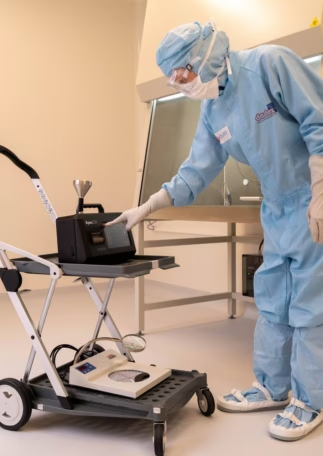
This third appendix also addresses three specific types of preparation in greater detail. First, it covers the preparation of sterile products. Second, it discusses the preparation of non-sterile liquids, creams, and ointments. Finally, it addresses the preparation of radiopharmaceuticals in healthcare facilities. Normec Advipro’s expertise spans several of these areas. For example, we are experts in sterilization validation for various processes. However, Normec Advipro not only possesses expertise in sterilization validation but also has state-of-the-art testing equipment to conduct these studies. In addition, we distinguish ourselves through our expertise in the field of cleanrooms. Here, too, this expertise encompasses both the preparation of documents and protocols or the provision of templates (User Requirements Specification (URS), Risk Analyses, validation and qualification documents, etc.) to the execution of these protocols by our Mobile Validation Experts (MoVE) using their state-of-the-art test equipment. If you need a Project Manager to ensure your project related to the transition to these regulations runs smoothly, Normec Advipro is the right choice for you.
Cleanroom support via the Cleanroom Implementation Blueprint (CLIMB)
With CLIMB, we offer a structured roadmap designed to guide organizations through the entire cleanroom process, from the initial steps of process mapping and design to the continuous monitoring of the operational cleanroom.
Ready for the Future?
Is your organization ready for the future of pharmaceutical and high-tech manufacturing? For many hospitals, laboratories, startups, and other organizations, building and validating a cleanroom in compliance with (new) regulations can be a major step into the unknown, often lacking specific expertise.
By engaging Normec Advipro, you gain access to targeted expertise and support to successfully complete your cleanroom project. It is essential to ensure quality in an innovative and validated production environment during the implementation of changes and improvements. This contributes to improved long-term cost efficiency , as every decision can impact the final commissioning.
Based on this experience, Normec Advipro has now developed its own Cleanroom Implementation Blueprint (CLIMB) to advise and support cleanroom project teams throughout the entire process with corresponding deliverables.
Your partner in quality, safety, and compliance
The life sciences sector requires specialized knowledge and reliable guidance. Thanks to our extensive expertise, we help organizations comply with laws and regulations, ensure quality, and continue to innovate with confidence.
Related services







Related Articles
28 Apr 2026
A Failed APS: Every Sterile Production Department’s Nightmare
A failed aseptic process simulation (APS) is every sterile production department’s nightmare. As soon as the culture medium becomes cloudy, alarm bells go off throughout the entire organization.
05 May 2025
Advipro Becomes Normec Advipro
Lille, May 5, 2025 – Advipro, an expert in consulting and project support within the life sciences sector, is taking a new strategic step. Starting in May 2025, the company will operate under the name Normec Advipro.


13 Sep 2024
Winter Mapping: Protect Your Temperature-Sensitive Products
Discover how mapping works and why it’s essential for addressing the challenges posed by controlled environments. We’ll outline the best practices for effective winter mapping.
31 Aug 2022
Where Can Normec Advipro Make a Difference? | PIC/S Standard
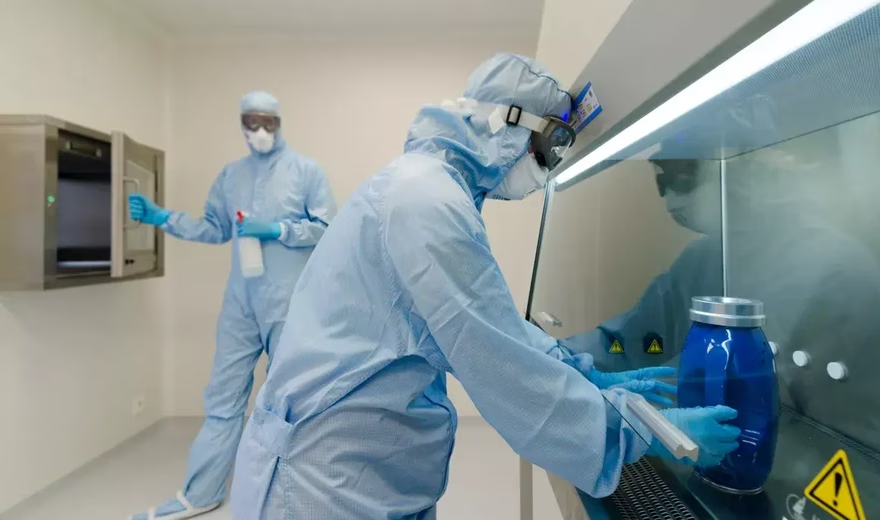
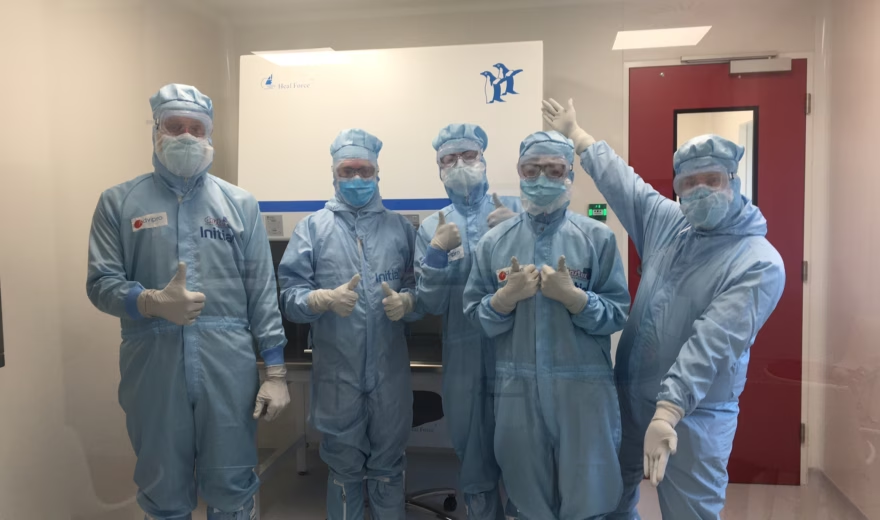
A new Royal Decree was recently published “concerning the preparation and dispensing of medicines and the use and distribution of medical devices within healthcare institutions.” You can read all about it in the blog “The New Regulations for Hospitals and Their Pharmacies.” Specifically, the regulations require work to be carried out in controlled environments (cleanrooms), where the handling of open containers must always take place in ventilated rooms with filtered air. For many hospitals, building and validating a cleanroom is a major undertaking, and they often lack the necessary in-house expertise. Collaborating with an expert like Normec Advipro offers enormous benefits. We work closely with the hospital and apply the “First Time Right” principle, which benefits the project’s quality, budget, and timeline. In the past, we’ve collaborated with various large and small hospitals, as well as university hospitals. Below, we outline a few project phases in which Normec Advipro provided real added value and share our three main lessons learned.


24 Feb 2022
5 Reasons to Choose a Career in Life Sciences
Choosing a career in pharma & life sciences is a forward-looking choice in a rapidly growing industry. But you must also make a conscious decision to enter this highly regulated and state-of-the-art sector.
16 Jun 2025
Summer Storage: Protect Your Temperature-Sensitive Products
Discover how mapping works and why it’s essential for addressing the challenges posed by controlled environments. We’ll outline the best practices for effective summer mapping.
24 Feb 2022
What is GxP?
Sooner or later, everyone comes into contact with medications, but we often don’t stop to think about everything that needs to be done to safely deliver a medication to the patient. When it comes to medications, patient safety is paramount. To ensure safety, various quality systems have been introduced in the pharmaceutical and food industries. These quality systems are divided into different categories. The general term for these quality systems is GxP. What does GxP mean, and why is it so important to implement quality systems in these industries?