



Understanding Human Error
While human errors are inevitable in a dynamic environment, they are particularly critical in the pharmaceutical sector due to their potential to have a harmful impact on patients. These errors can have various causes, ranging from cognitive limitations and insufficient training to communication breakdowns and design flaws in processes and systems.
The Categories of Human Errors
First and foremost, it is of the utmost importance to understand the different categories of human errors. By gaining insight into the underlying causes of these errors, we can integrate strategies to reduce them into the corporate culture and procedures.
Below, we list the categories of human error:
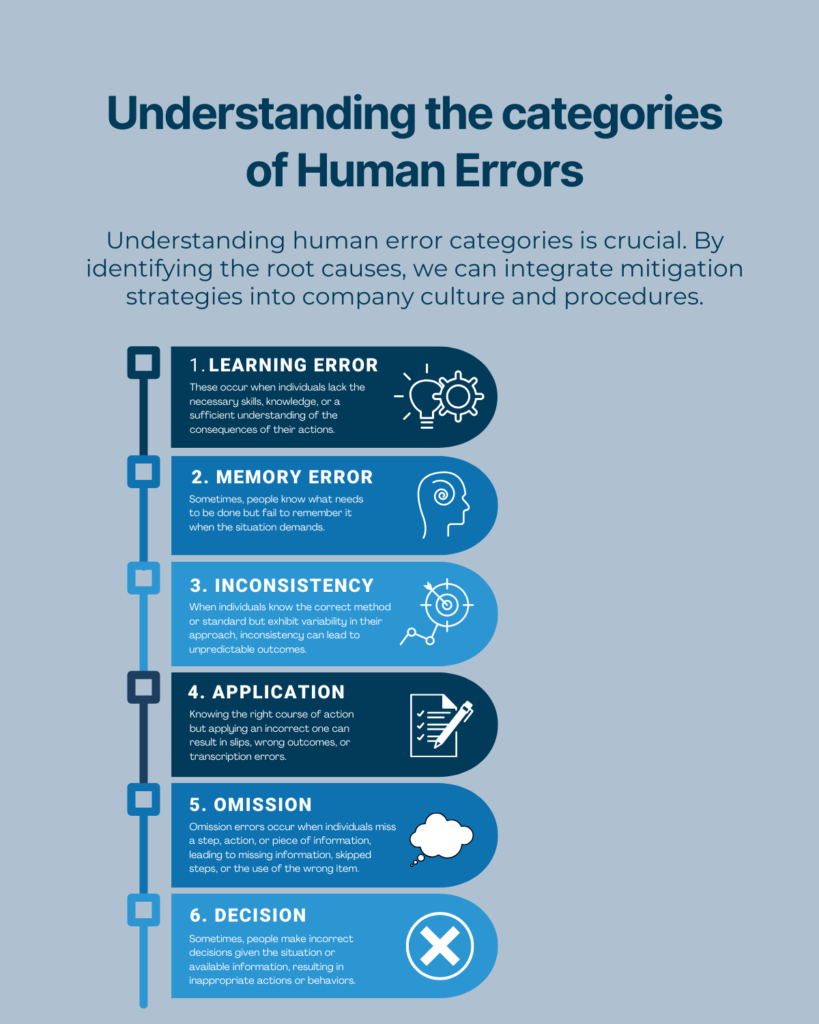
- Learning errors: These occur when individuals lack the necessary skills, knowledge, or a sufficient understanding of the consequences of their actions. Ongoing training and education are essential to reducing learning errors.
- Memory errors: Sometimes people know what needs to be done but forget it when the situation calls for it. Memory aids, checklists, or reminders can help reduce memory errors.
- Inconsistency errors: When people know the correct method or standards but vary in their approach, inconsistency can lead to unpredictable results. Establishing clear procedures and guidelines is crucial to reducing inconsistency errors.
- Application errors: Knowing the correct procedure but applying it incorrectly can lead to errors, incorrect results, or carryover errors. Implementing verification processes and double-checks can be effective in preventing application errors.
- Omission errors: Omission errors occur when individuals overlook a step, action, or piece of information, which can lead to missing information, skipped steps, or the use of the wrong item. Robust procedures and thorough reviews can help prevent errors related to omissions.
- Decision-making errors: Sometimes people make incorrect decisions given the situation or the available information, which can lead to inappropriate actions or behaviors. Promoting a culture of open communication and collaboration can reduce decision-making errors by facilitating collective decision-making and feedback.
By understanding these common categories of human error and implementing strategies to address them, organizations and individuals can significantly reduce the likelihood of errors, leading to improved efficiency, safety, and overall performance within the corporate culture.
Control Hierarchy for Human Errors
Human errors can occur in any workplace, but they are often symptoms of an underlying problem. Understanding the root causes of these errors is crucial for implementing effective management strategies. Below, we explore a structured approach to managing and reducing human errors. Let’s take a closer look at the hierarchy of management strategies:
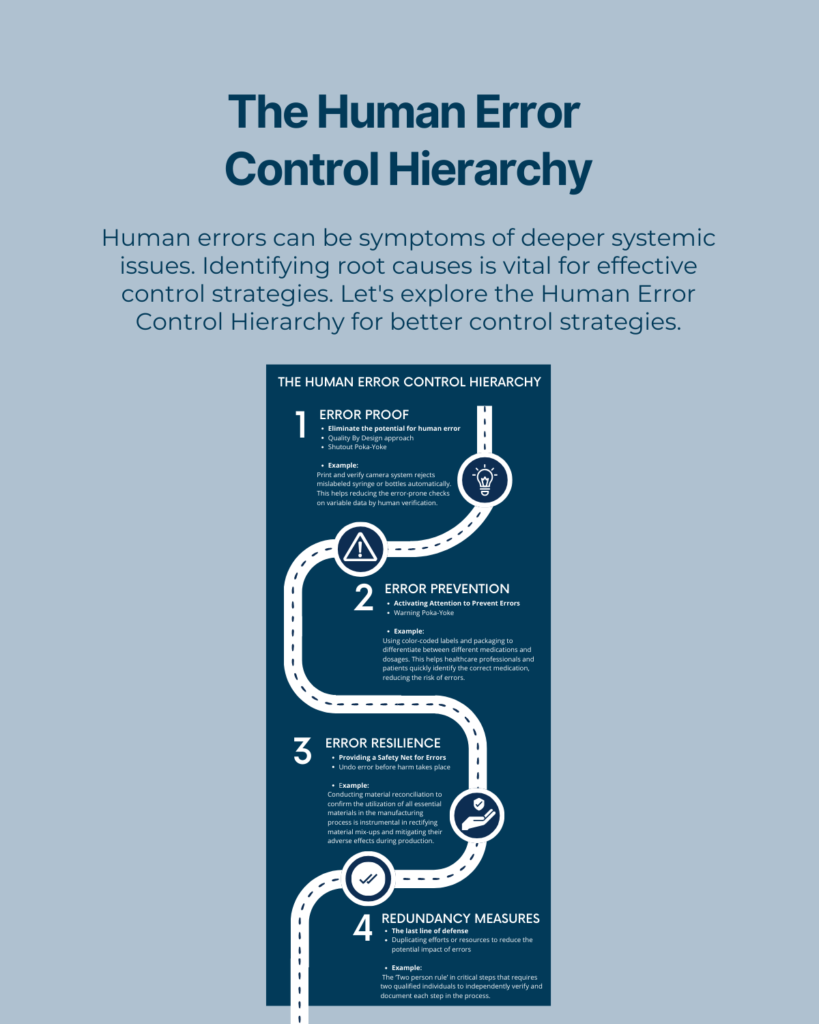
1. Error-proofing: eliminating the possibility of human error
At the top of our hierarchy is “error-proofing,” the gold standard for preventing human errors. This approach, also known as Shutout Poka-Yoke, focuses on making it physically impossible to proceed if a step is skipped or performed incorrectly. It’s all about designing systems and processes in a way that leaves no room for error.
Consider, for example, a printing system with a verification camera that automatically identifies and rejects aerosol cans or bottles with labeling errors, thereby reducing the need for error-prone, manual checks of variable data.
2. Error Prevention: Encouraging Attention to Prevent Errors
Next, we have error prevention, a proactive approach aimed at detecting errors before they occur. Often referred to as “Warning Poka-Yoke,” this strategy uses devices or systems that alert users to potential errors. These warnings provide immediate feedback and help people correct their actions before errors can escalate further.
Consider, for example, the use of color-coded labels and packaging to distinguish between different medications and dosages. This helps healthcare providers and patients quickly identify the correct medication and reduces the risk of errors.
3. Error resilience: providing a safety net for errors
Error-proofing revolves around creating systems that allow people to correct errors before they cause harm. It acknowledges that errors can still occur despite the best preventive efforts. In such cases, mechanisms for quickly correcting errors can be invaluable.
For example, consider conducting a reconciliation to confirm the correct use of all essential materials in the production process. This is essential for preventing mix-ups and minimizing their adverse consequences during production.
4. Redundancy Measures: The Last Line of Defense
Finally, there are redundancy measures, which serve as the last line of defense against errors that manage to bypass earlier safeguards. These measures involve duplicating efforts or resources to reduce the potential impact of errors.
Consider, for example, the “two-person rule” for critical steps, whereby two authorized individuals must independently verify and document each part of the process. Or, for instance, backup systems and contingency plans. These measures can help limit the consequences of an error and keep a situation under control if all other measures fail.
Conclusion
As experts in quality assurance within the pharmaceutical industry, our mission is to ensure safety, precision, and quality at every step. By gaining insight into the multifaceted nature of human error and implementing a structured approach, such as the control hierarchy mentioned above, we can create a culture of excellence in which patient safety and continuous improvement are second nature.
If you’re committed to reducing errors and improving patient well-being, let’s work together. Contact us today to discover how our expertise in quality assurance can benefit your business.
Your Partner in Quality, Safety, and Compliance
The life sciences sector requires specialized knowledge and reliable guidance. Thanks to our extensive expertise, we help organizations comply with laws and regulations, ensure quality, and continue to innovate with confidence.
Related Services


Related Articles


10 Jul 2026
The position of a Responsible Person and Designated Person within pharmaceutical distribution
In the multifaceted domain of pharmaceutical distribution, adherence to Good Distribution Practices (GDP) serves as a cornerstone, ensuring the integrity and safety of products across the entire supply chain. Within the European landscape, GDP guidelines meticulously outline the roles and responsibilities of key personnel involved in this pivotal process. A nuanced understanding of these directives is crucial, particularly concerning Finished Medicinal Products and Active Pharmaceutical Ingredients (APIs), each governed by its distinct regulatory framework.


10 Jul 2026
Reduced Testing in Supply Chain Management: A counterintuitive Shift?
In the ever-evolving landscape of supply chain management, one trend gaining traction is the reduced testing of incoming materials. This approach, while initially counterintuitive, offers several strategic advantages that can lead to significant improvements in efficiency, cost savings, and even quality assurance. Here’s a closer look at why more pharmaceutical companies are considering this shift and how it can be effectively implemented.
10 Jul 2026
The Fight Against Counterfeit Medicines – U.S. Edition
A few months ago, our consultant Clara wrote a blog post about serialization and the fight against counterfeit medicines. She explained the principle of serialization for medicines distributed on the European market and cited Ozempic as an example. In this blog, our consultant Esther will take a closer look at the serialization requirements across the Atlantic, specifically in the United States.
10 Jul 2026
Maximizing Excellence – The Importance of Annual Product Quality Reviews
In the dynamic landscape of pharmaceutical manufacturing, ensuring quality, safety and efficacy of medicines is key. One of the tools to ensure this is the Annual Product Quality Review (APQR also known as APR or PQR), it is a critical process mandated by regulatory authorities and embraced by industry leaders. In this blog we delve into the regulatory requirements, benefits, and challenges of the APQR.
10 Jul 2026
Technology Transfer in Pharmaceutical Manufacturing
In this blog, a high-level introduction is given with respect to technology transfer in pharmaceutical manufacturing.
10 Jul 2026
The Art of Auditing in the Life Sciences Industry: An In-Depth Look Through the Eyes of a Lead Auditor
In this blog post, our colleague Lars Pinxten, a lead auditor with over 10 years of experience in the pharmaceutical industry, takes you on a journey through the challenging world of auditing. From understanding the concept of first-, second-, and third-party audits to sharing practical tips and tricks for a successful audit.
10 Jul 2026
Unlocking Success for your professional and personal life? DMAIC Problem-Solving Methodology to the rescue!
Believe it or not, the principles of Six Sigma can be applied to everyday life. In fact, you’re probably following some of them without even realizing it. During this journey, we’ll examine the DMAIC (pronounced as də-MAY-ick) strategy, a core aspect of Six Sigma. DMAIC is used to help solve problems and improve processes. We all strive for success, both in our professional careers as in our daily life, but along the way of trying to reach this success we come across a multitude of problems. Thankfully, DMAIC is here to help!