


Understanding Ionizing Radiation to Develop Effective Radiation Protection
What do they have in common? They carry enough energy to ionize matter—that is, to knock electrons out of the atoms they pass through. This property makes them both useful—particularly in medical imaging and treatment—and potentially hazardous to human health.
What Is Ionizing Radiation?
Ionizing radiation is radiation capable of causing ionization of matter. According to standard definitions (INRS, ASNR), this ionization can damage biological cells and lead to health effects, particularly in the event of uncontrolled exposure.
There are two main types:
- Particle radiation (alpha and beta)
- Electromagnetic radiation (gamma and X-rays)
Their danger depends mainly on three factors:
- their penetrating power,
- their ionizing capacity,
- the conditions of exposure (external or internal).
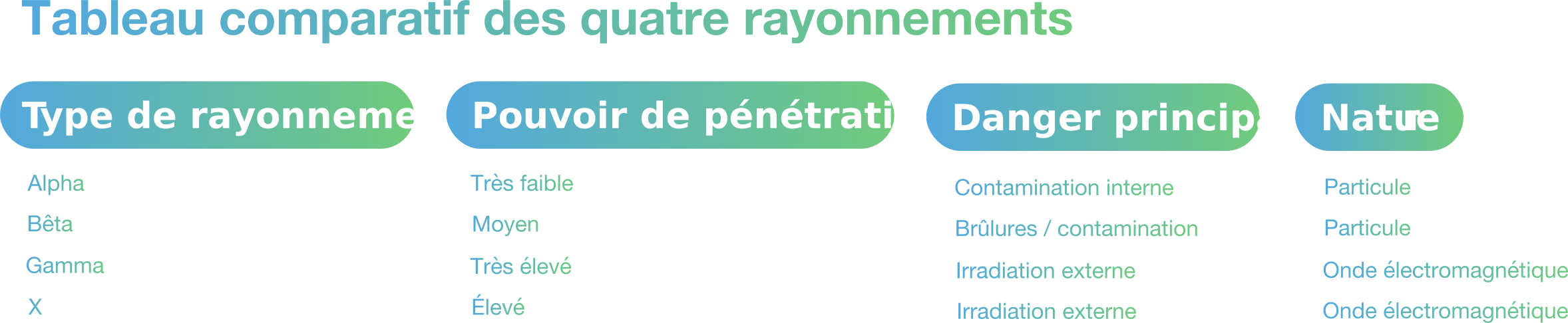
Alpha (α) rays: highly ionizing but have low penetrating power
Alpha radiation consists of particles made up of two protons and two neutrons (helium nuclei). They are emitted during the decay of certain heavy radioactive elements such as uranium or radium.
Penetration power
Very low.
A single sheet of paper or the outermost layer of the skin is sufficient to stop them.
Main risk
The danger arises in the event of internal exposure (inhalation or ingestion of radioactive particles). Inside the body, their high ionizing power can cause significant cellular damage.
In practice: Alpha radiation risk primarily concerns environments where unsealed sources are handled.
Beta (β) rays: moderate penetration
Beta radiation consists of electrons (β−) or positrons (β+). It also results from radioactive decay.
Penetration power
Moderate.
They penetrate a few millimeters of biological tissue and can be stopped by an aluminum plate or a suitable plastic shield.
Main risk
- Skin burns in the event of significant external exposure
- Increased risk in the event of internal contamination
In the workplace, protection relies on appropriate shields and rigorous management of the risk of contamination.
Gamma (γ) rays: highly penetrating
Gamma rays are electromagnetic waves emitted by the nucleus of an unstable atom during its de-excitation.
Penetration power
Very high.
They easily pass through the human body and require heavy shielding (lead, thick concrete).
Main risk
External whole-body exposure.
This is why environments that use gamma sources (industry, nuclear medicine) must incorporate collective protection measures, dosimetric monitoring, and strict procedures.
X-rays: similar to gamma rays but of a different origin
X-rays are also a form of electromagnetic radiation.
The main difference from gamma rays lies in their origin:
- Gamma rays originate from the atomic nucleus.
- X-rays are produced by electron interactions, particularly in the X-ray tubes used in medical imaging.
Penetration Power
High, comparable to gamma rays depending on their energy.
Main uses
- Medical radiology
- CT scans
- Industrial inspections
As with gamma rays, protection relies on:
- shielding,
- limiting exposure time,
- maintaining a safe distance from the source.
From Theory to Practice: Effectively Organizing Radiation Protection
In the workplace, managing ionizing radiation goes beyond scientific knowledge. It involves:
- Risk assessment
- Exposure monitoring
- Regulatory traceability
- Updating documentation
- Coordinating action plans
This is precisely where organizations encounter difficulties: a growing number of obligations, complex document management, and time-consuming regulatory compliance.
In conclusion
Alpha, beta, gamma, and X-ray radiation have distinct physical characteristics that determine their level of hazard and the necessary protective measures.
Understanding these differences is the first step toward effective radiation protection. The second step is to establish a sustainable risk management framework.
In a demanding regulatory environment, relying on a dedicated tool like ABGX helps ensure safe practices, optimize your organization, and provide greater peace of mind.
Your Partner for Quality, Safety, and Compliance
The life sciences sector requires specialized knowledge and reliable support. Thanks to our in-depth expertise, we help organizations comply with laws and regulations, ensure quality, and continue to innovate with confidence.
Related Services






Related Articles


15 Apr 2026
5 Key Factors for Success in Implementing Your CSR Initiative
In radiation protection, limiting exposure to ionizing radiation is a top priority. This is the context for the ALARA principle, a fundamental rule applied in the medical, industrial, and nuclear sectors
25 Mar 2026
Understanding the ALARA Principle in Radiation Protection
In radiation protection, limiting exposure to ionizing radiation is a top priority. It is in this context that the ALARA principle applies—a fundamental rule used in the medical, industrial, and nuclear sectors.


25 Mar 2026
What content should you include in your POPM?
The POPM is a key document for organizing medical physics within healthcare facilities that use ionizing radiation. But what elements should it include?


12 Mar 2026
Radiation Protection: What Is a Calculation Note?
In facilities that use ionizing radiation—whether for medical, industrial, or research purposes—the issue of radiation protection is of paramount importance.


09 Mar 2026
The BIG Regulatory FAQ: Why You Should Watch the Replay
Between upcoming changes regarding radiation protection experts, questions about radon, zoning, radioactive waste, and regulatory inspections, many professionals are facing the same challenge: understanding what’s actually changing and knowing what’s mandatory… and what isn’t.


13 Jun 2025
DUERP: How to Comply with Regulations While Saving Time?
My DU: A Simple and Powerful Tool Developed by the ASCND Innovation Center