Before dosing, the TAs were prepared in dimethyl sulfoxide (DMSO), so neat extraction and calibration standards and QCs were required. The challenge was to develop and validate a single HPLC UV method that could simultaneously separate and quantify all the TAs and their potential impurities in different formulations and to apply the method for testing the TAs in the formulation. This involved HPLC method development to ensure accurate and precise analysis.
Subsequently, the established method was applied to test the TAs within the formulation, underscoring the importance of robust HPLC UV analysis method development for pharmaceutical analysis. Gradient elution was employed in developing the chromatographic method to enhance resolution and sensitivity, further showcasing the superiority of HPLC UV over UV spectrophotometry in complex pharmaceutical analyses in the case of HPLC vs UV spectrophotometry. The HPLC-UV chromatogram was utilized to assess the peak purity and resolution of the analytes.
Solution
A systematic approach was adopted for the method development and validation of HPLC UV, following the International Council for Harmonization (ICH) guidelines. During the HPLC method development, the chromatographic conditions, such as the column type, mobile phase composition, pH, flow rate, and detection wavelength, were optimized using a design of experiments (DOE) strategy to produce high-quality HPLC-UV chromatograms. Employing gradient elution, the HPLC UV analysis method’s robustness and efficiency were further enhanced to ensure optimal separation and resolution of analytes, resulting in clear and well-defined HPLC-UV chromatograms. This approach showcases the advantages of HPLC vs UV spectrophotometry in providing superior resolution and specificity in pharmaceutical analysis.
The HPLC UV method validation included the method performance parameters, such as specificity, linearity, accuracy, precision, robustness, limit of detection, and limit of quantification. The HPLC UV analysis method was validated for each TA and its impurities in the corresponding formulation matrix. The method was also tested for its applicability for stability studies of the TAs in formulation. Thus, integrating gradient elution into the HPLC method development established a comprehensive and reliable analytical framework, meeting the stringent requirements of pharmaceutical analysis. This highlights the importance of utilizing HPLC vs UV spectrophotometry to achieve precise and accurate results in pharmaceutical research and development.
Outcome
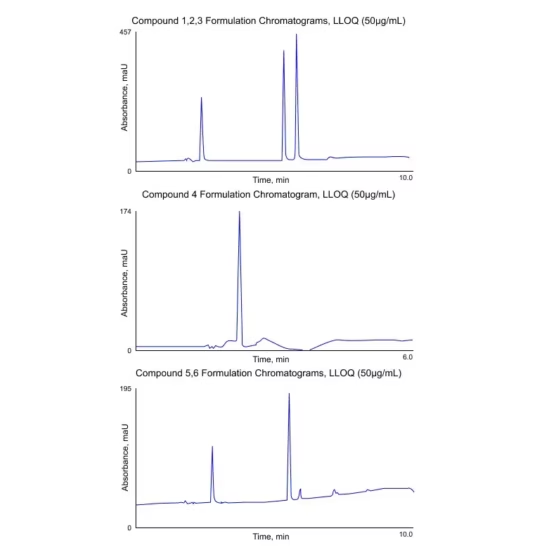
A robust and reliable HPLC UV method was developed and validated to analyze five TAs simultaneously. HPLC method development was crucial in achieving this goal, ensuring optimal separation and detection of the analytes. Due to similar structures and retention times of 2 sets of the TAs, the HPLC UV analysis method validation was separated into two validations using the same parameters. One of the validations had 2 test articles, and the other validation was run with the other 3 TAs. The method showed good separation of all the analytes within 10 minutes at a 254nm wavelength, using an Agilent XDB- C18 column and a gradient elution of acetonitrile: methanol (1:1) with 0.1% Formic Acid and acidified water with 0.1% formic acid. This gradient elution strategy facilitated the effective separation of the target analytes within a short runtime of 10 minutes, ensuring accurate quantification and detection. Gradient elution is known for enhancing chromatographic resolution by varying the composition of the mobile phase over time. The HPLC-UV chromatogram displayed distinct peaks for each analyte, confirming the successful separation and detection of the target compounds.
The HPLC UV analysis method was precise and accurate, with recoveries between 95 and 105% and relative standard deviations less than 5% for all the analytes. The method was robust, with no significant changes in the results under different experimental conditions. Comparatively, HPLC vs UV spectrophotometry showed superior precision and accuracy, enhancing confidence in the obtained results. The HPLC method development was sensitive, with limits of detection and quantification in the range of 50.00 to 300.00 μg/mL for all the analytes.
The method was successfully applied for the stability of the TAs in formulation at room temperature and -70°C for up to 10 days, and the results were consistent with the specifications. The HPLC-UV chromatogram further confirmed the specificity and reliability of the method. The HPLC UV method demonstrated its versatility and efficiency for analyzing five TAs and their impurities in different formulations and could be used for quality control and regulatory purposes.
Speak To Our Scientist About Your HPLC-UV Method Development: Testing 9 Articles in Formulation
Related articles
MSD Hybridization ELISA PK Immunoassay Development, GLP Validation, And Oligonucleotide Analysis

TaqMan Gene Expression Assay, Copy Number Variation Assay Development, nGLP Validation, And Sample Analysis
LC MS Method for Everolimus Eluting Coronary Stent Drug Delivery Systems

Genomic Variation Analysis – TaqMan Single Nucleotide Polymorphism (SNP) Analysis

LC MS Bioanalysis Of Antisense Oligonucleotide (ASO) Using Mass Spectrometry And Ion Pair Chromatography
Epigallocatechin Gallate (EGCG) LC MS Method Development, GLP Validation, And Sample Analysis In VcEDTA Human Serum
LC MS Method For Proline Amino Acid, Hydroxyproline In Mouse Tissues
LC MS Method For DNA Adducts Analysis In Cell-Based In-Vitro Samples

Mass Spectrometry Amino Acids, Quantitative LC MS Amino Acid Analysis

LC MS Method Development And GLP Validation For Human Plasma PK Sample Analysis
Incurred Sample Reanalysis (ISR) Test, FDA Requirements, And Study Evaluation
Dried Blood Spot (DBS) Sampling, DBS Collection, And DBS Analysis
Your partner in quality, safety, and compliance
The life sciences sector requires specialized knowledge and reliable support. With our broad expertise, we help organizations comply with laws and regulations, ensure quality, and continue to innovate with confidence.