A defensible qualification program demonstrates that the selected agents, application methods and procedures are effective under the conditions in which they will actually be used. It should also show that trained operators can perform the process consistently and that the supporting data remain relevant throughout the program lifecycle.
This article focuses on non-product-contact cleanroom surfaces and external equipment surfaces. Product-contact equipment cleaning validation, CIP/COP studies and product-residue carryover are outside its main scope.
Why cleaning and disinfection qualification matters
EU GMP Annex 1 treats cleaning and disinfection as part of contamination control. Sections 4.33 to 4.36 address written programs, the need for cleaning before disinfection, the use of more than one type of disinfecting agent, periodic use of a sporicidal agent, validation of the disinfection process and controls for disinfectants and detergents used in Grade A and Grade B areas.
Supporting references such as ISO 14644-5, USP <1072>, FDA guidance on aseptic processing and PDA Technical Report No. 70 can provide additional operational or technical context. The qualification approach should, however, be tailored to the facility, its microbial flora, materials, processes and contamination risks.
When the objective is to demonstrate that disinfectants and procedures work on relevant cleanroom surfaces, a dedicated Disinfection Validation study can provide the evidence needed to support the contamination control strategy and the approved procedures.
What inspectors expect to see
Inspectors are unlikely to assess a qualification program on laboratory efficacy data alone. They will look for a clear connection between the risk assessment, selected products, study design, operating procedures, routine monitoring and lifecycle review.
- A documented rationale for the cleaning agents, disinfectants, concentrations and minimum contact times selected.
- Evidence that the program covers relevant bacteria, yeasts, moulds and, where required, bacterial spores.
- Data generated with appropriate neutralisation, non-toxicity and recovery controls.
- Testing on representative cleanroom materials and against relevant environmental isolates from the facility.
- Procedures that clearly define preparation, application, wet contact time, wiping or mopping technique and residue removal.
- Operator training and evidence that the approved process can be reproduced during routine work.
- Risk-based sampling, predefined acceptance criteria, trend review and documented reassessment after meaningful change.
The strongest programs show how these elements work together. A well-designed laboratory study cannot compensate for an unclear SOP, an unrealistic contact time or inconsistent execution in the cleanroom.

The three levels of qualification
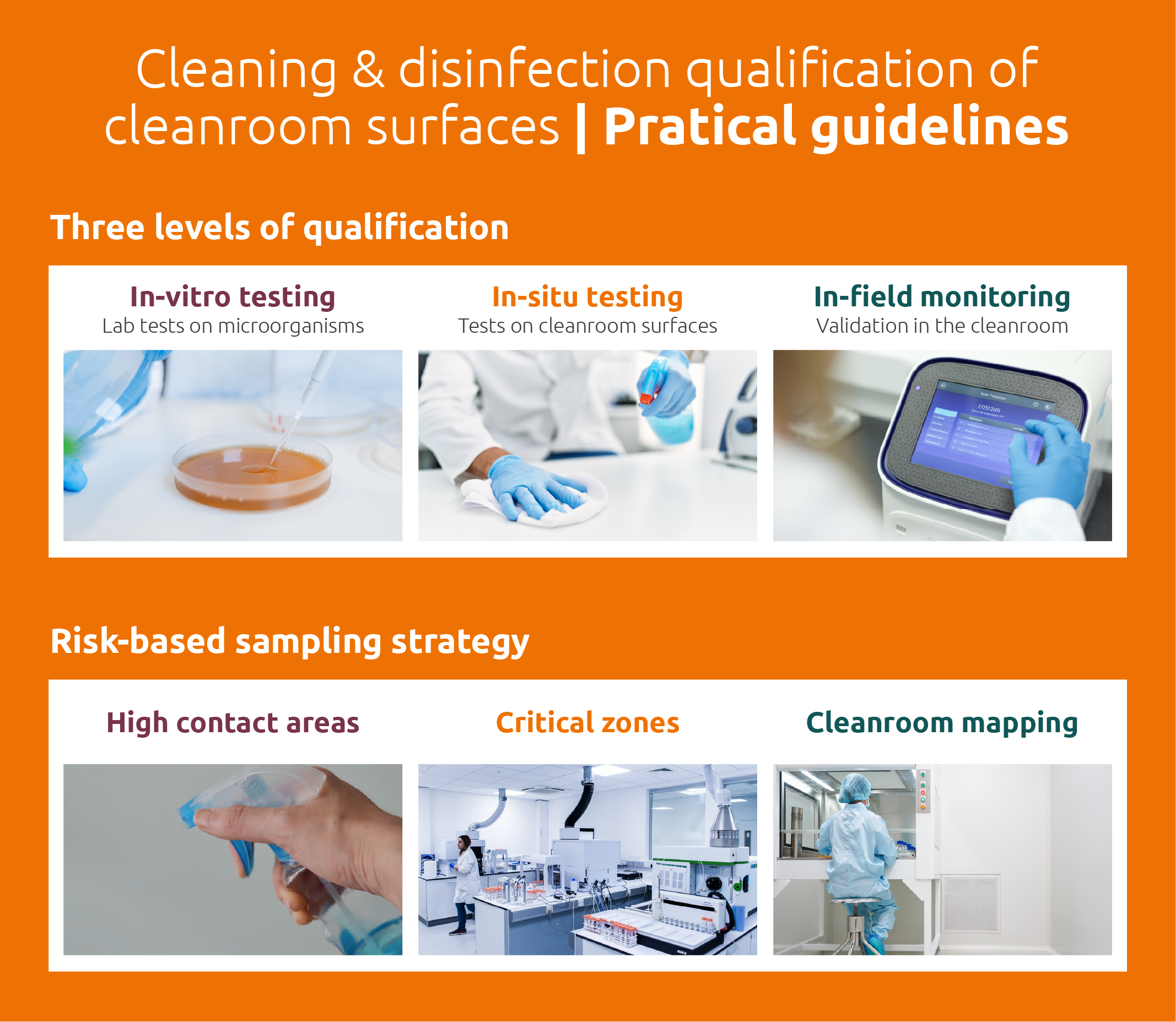
Cleaning and disinfection qualification is commonly built in three complementary levels: in-vitro testing, in-situ surface studies and in-field verification. Moving from controlled laboratory testing to actual use conditions helps establish both antimicrobial efficacy and operational reproducibility.
1. In-vitro testing
The first level evaluates candidate agents under controlled laboratory conditions. Products should be tested at the concentration and shortest contact time that will be specified in the procedure, rather than only under the manufacturer’s most favourable claim conditions.
Depending on the intended claim and scope, commonly used methods may include:
- Quantitative suspension tests, such as EN 1276 or EN 13727 for bactericidal activity, EN 1650 or EN 13624 for yeasticidal or fungicidal activity, EN 13704 for sporicidal activity and EN 14476 for virucidal activity.
- Carrier or surface testing, such as EN 13697, to evaluate activity on a non-porous surface without relying on mechanical action.
- Contact-time studies using the minimum wet contact time that operators must achieve in routine practice.
- Neutraliser efficacy, neutraliser non-toxicity and recovery-efficiency controls.
Neutralisation is a critical control. If residual disinfectant remains active after sampling, microbial reduction may appear greater than the reduction achieved at the defined contact time. This can undermine the validity of the complete data set.
Testing should not stop at compendial strains. Representative environmental isolates from the facility should also be included, especially recurrent, resistant or spore-forming organisms identified through the environmental monitoring program.
2. In-situ testing on representative surfaces
The second level evaluates selected agents on coupons made from materials used in the cleanroom. These may include stainless steel, epoxy floor coating, vinyl, glass, polycarbonate and specific equipment finishes. The study should represent the intended concentration, minimum wet contact time, application method and relevant worst-case conditions.
- Microbial reduction on each representative material against predefined, scientifically justified acceptance criteria.
- Material compatibility after repeated application, including corrosion, staining, crazing and residue build-up.
- The influence of surface condition, configuration or accessibility on effective application.
- Whether the required contact time and residue-removal steps are feasible without unacceptable disruption to operations.
Where a broader instruction package must be demonstrated as effective and reproducible, including cleaning or sterilisation steps provided for a medical device or other reusable item, Validation of Cleaning and Sterilization Instructions can support the validation of those instructions under defined use conditions.
3. In-field verification in the operational cleanroom
The final level verifies the approved process in the operational environment and with the operators who will perform it routinely. This is where implementation weaknesses typically become visible. Examples include failure to maintain the required wet contact time, inconsistent wiping or mopping technique, sampling at an undefined point in the cleaning cycle and ineffective residue removal.
Relevant monitoring methods include:
- Contact plates where the surface and recovery method are suitable.
- Swabs for small, irregular or difficult-to-access surfaces.
- ATP bioluminescence as a rapid supporting and trending tool. Because ATP measures organic residue rather than microbial kill, it should not be used as the primary evidence of disinfection efficacy.
Sampling should take place at a predefined point after cleaning and disinfection. Locations should be selected on the basis of risk, not convenience. The field study should also include direct observation of solution preparation, application technique, wiping or mopping pattern, wet contact time and residue removal.
How to build a risk-based sampling strategy
Not every cleanroom surface presents the same contamination risk. A documented assessment should therefore determine where sampling is most informative, how frequently it is required and how results will be interpreted alongside environmental monitoring data.
Important risk factors include:
- Frequency and type of operator, material or equipment contact.
- Proximity to critical production zones, open product or exposed components.
- Material type, surface finish and susceptibility to microbial adhesion or biofilm formation.
- Accessibility, including whether the surface is difficult to reach or clean consistently.
- Historical environmental monitoring results and the recurrence of specific environmental isolates.
- Events or changes that may alter the contamination risk, such as maintenance, layout changes or new equipment.
A practical starting point is a cleanroom map with clear zoning. Mark high-touch and high-risk points such as door handles, work surfaces, equipment controls, transfer hatches and floors near critical areas. Link each location to its rationale, sampling method, frequency and applicable procedure. Reassess the map when the process, layout, materials or facility flora change.
How to define cleaning and disinfection frequencies
Cleaning and disinfection frequencies should be justified within the written program. The decision should reflect cleanroom grade, process risk, environmental monitoring history and event-based triggers rather than relying on a generic schedule.
- Cleaning should take place before disinfection when surface contamination could interfere with disinfectant efficacy.
- Disinfectants and detergents used in Grade A and Grade B areas should be sterile before use. The contamination control strategy may identify situations in other grades where sterility is also needed.
- Prepared or diluted solutions should have a defined and supported in-use expiry and should be stored in suitable containers.
- Procedures should define how residues are removed where necessary, particularly after use of a sporicidal agent.
- Where cleaned or disinfected surfaces remain unused, the program should consider whether a justified clean hold time is required.
Operator competence is part of process control
A technically sound procedure will only remain effective if operators understand and reproduce it. Training should therefore cover the difference between cleaning and disinfection, solution preparation, application sequence, wiping or mopping technique, contact-time control, residue removal and documentation expectations.
Teams that need to strengthen this knowledge can use Cleaning Validation Training to build a shared understanding of cleaning validation principles and their practical application in a regulated environment.
Common qualification pitfalls
- Relying on one antimicrobial mode of action or omitting the periodic sporicidal step.
- Using supplier efficacy claims without confirming the actual concentration, contact time, surfaces and facility organisms.
- Transferring suspension-test acceptance criteria directly to coupon studies without a study-specific rationale.
- Failing to assess material compatibility and the cumulative effect of repeated application.
- Leaving the distinction between cleaning and disinfection unclear in procedures.
- Testing only compendial strains and excluding relevant environmental isolates.
- Generating efficacy data without validated neutralisation and recovery controls.
- Using ATP results as primary evidence of microbial kill.
- Providing training without verifying consistent execution in the operational cleanroom.
- Failing to trend data or reassess the program after significant change.
Keeping the program effective throughout its lifecycle
Qualification is not a one-off exercise. The program should remain aligned with the facility, the contamination control strategy and the organisms actually recovered through environmental monitoring. Periodic review should consider trends, deviations, CAPAs, changes in disinfectants or suppliers, revised procedures, new materials, equipment changes and shifts in the environmental isolate profile.
Strong document control is essential because the qualification rationale, approved procedures, training records, deviations, CAPAs and review decisions must remain connected and retrievable. A digital quality management system such as QFacts eQMS can support controlled quality documentation and related quality processes.
Conclusion
A defensible cleaning and disinfection qualification program connects laboratory efficacy, representative surface testing and operational verification. It uses risk to select sampling locations and frequencies, includes relevant facility isolates, verifies neutralisation and recovery, addresses material compatibility and confirms that operators can perform the procedure as written.
When these elements are integrated into the contamination control strategy and reviewed throughout the lifecycle, cleaning and disinfection become demonstrably controlled processes rather than routine activities supported only by supplier claims or isolated test results.
About Normec Advipro
Normec Advipro ensures that your organization in life science operations complies with regulations while also maintaining sustainable compliance. With our expertise in GMP, ISO standards, the FDA, the EMA, and other regulatory bodies, we implement smart solutions that ensure regulatory compliance and improve operational efficiency. From project initiation to periodic requalification: we support you at every stage to ensure optimal performance and risk management.
About Farma Consulting
Farma Consulting & Partners aims to be the reference for QA, QP, qualification and validation activities within the life sciences sector. We build sustainable, long-term relationships with our clients, with one goal: bringing your products to market safely, and implementing, optimising and validating your quality system efficiently. We continuously challenge the status quo. In a strictly regulated pharmaceutical sector, processes and systems are often approached conservatively — with our expertise in the applicable regulations, we are committed to helping our clients operate in the most efficient way possible.
Your Partner for Quality, Safety, and Compliance
The life sciences sector requires specialized knowledge and reliable support. With our comprehensive expertise, we help companies comply with laws and regulations, ensure quality, and continue to innovate with confidence.
Related Services
Related Articles
07 Sep 2026
Three Years Into Annex 1: What Inspectors Are Actually Asking For
In the pharmaceutical industry, contamination control is not just about meeting regulatory requirements. It determines whether product quality and patient safety can be demonstrated – and, in practice, whether a batch can be released and a facility can keep running.


14 Aug 2026
What do you know about EudraLex Volume 4 Annex 11:2026? Are your computer systems inspection ready?
The current version of Eudralex Volume 4 Annex 11 dates back to 2011 and is no longer fully up to date. The technological world has changed significantly since then. Requirements for lifecycle management and data integrity have become much stricter, and the use of cloud solutions in the pharmaceutical industry is now standard. Regulatory bodies such as EMA and PIC/S have indicated plans to revise Annex 11 to provide more clarity on its interpretation, guidelines for new technologies, and clear requirements for data integrity.
28 Apr 2026
A Failed APS: Every Sterile Production Department’s Nightmare
A failed aseptic process simulation (APS) is every sterile production department’s nightmare. As soon as the culture medium becomes cloudy, alarm bells go off throughout the entire organization.


16 Mar 2026
What do you know about EudraLex Volume 4 Annex 11:2026? Are your computer systems inspection ready?
The current version of Eudralex Volume 4 Annex 11 dates back to 2011 and is no longer fully up to date. The technological world has changed significantly since then. Requirements for lifecycle management and data integrity have become much stricter, and the use of cloud solutions in the pharmaceutical industry is now standard. Regulatory bodies such as EMA and PIC/S have indicated plans to revise Annex 11 to provide more clarity on its interpretation, guidelines for new technologies, and clear requirements for data integrity.
16 Mar 2026
What Is Involved in Building a Cleanroom? | PIC/S Standard for Hospitals
A new Royal Decree was recently published “concerning the preparation and dispensing of medicines and the use and distribution of medical devices within healthcare institutions.” You can read all about it in the blog “The new regulations for hospitals and their pharmacies.” In practical terms, this means that starting January 1, 2026, stricter requirements will also be imposed on how medications are prepared in hospitals. This is referred to as GPP, which stands for Good Preparation Practices. It is therefore expected that work will be carried out in controlled environments, where the handling of open containers must always take place in ventilated rooms with filtered air. In other words, hospitals will also have to install and validate a cleanroom with an associated quality system for their compounding activities.


16 Mar 2026
The New Regulations for Hospitals and Their Pharmacies
The pharmaceutical industry has been operating according to very strict guidelines for decades. The primary objective of these guidelines is to ensure patient safety. But in addition to the pharmaceutical industry, there are other settings where products for patients are prepared. These include, for example, pharmacies, clinical laboratories, and hospitals. In these settings as well, regulations are becoming stricter, and operations are increasingly subject to scrutiny. Consequently, these regulations are aligning more and more closely with those of the pharmaceutical industry—an area in which Normec Advipro has been building its expertise for nearly 20 years.
25 Jan 2026
Paperless validation: (im)possible?
In this blog, Steven takes you on a journey into the world of paperless validation. Find out exactly what it entails and how you can apply it in practice. Steven shares his experiences and explains the challenges and developments surrounding this new method.